
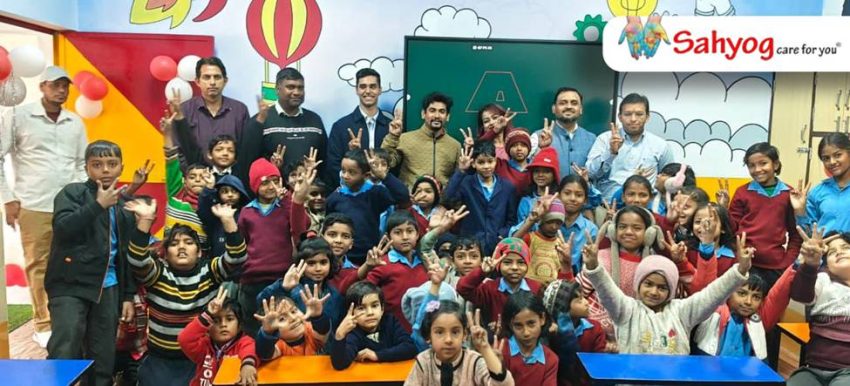
Dispatch One: A Classroom in Kashmir
The paint has given up in patches along the back wall. Damp has crept up from the floor, curling the plaster at the edges. When it rains, which it does often here, water finds its way in somewhere near the window frame, and the lesson pauses while someone drags a bucket over. The blackboard is chalk-scarred nearly white in the centre, worn thin from decades of the same lesson, written and erased, written and erased.
Dispatch Two: A Classroom in Tamil Nadu, Nearly 3,000 Kilometers South
Different state, different language on the walls, different climate entirely, humid instead of cold. And yet the room could be a twin of the one in Kashmir. Same discoloured plaster. Same poor ventilation trapping heat instead of damp. Same blackboard, same chalk, same story repeating itself nearly three thousand kilometers away.
The Same Problem, Wherever You Look
This isn’t a coincidence, it’s a pattern. Walk into government school classrooms across India, from mountain villages to city slums, and this scene repeats with striking consistency: peeling walls, dim lighting, a blackboard that’s seen better decades. It’s not a lack of curiosity holding these students back, it’s a lack of infrastructure. And as the world moves further into a digital-first economy, a child’s ability to engage with technology in the classroom is becoming as fundamental as reading and arithmetic, which means this gap isn’t a nice-to-have fix anymore, it’s foundational to educational equity itself.
The Rebuild: What Actually Changes in the Room
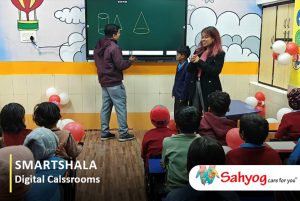
This is exactly the gap Sahyog Care For You, working on the ground across India since 2002, built its SmartShala programmed to close. Unlike interventions that simply drop a smartboard into a room and call it finished, SmartShala rebuilds the whole classroom, treating technology as one part of a larger fix rather than the entire solution.
The rebuild typically includes a full smartboard system with the necessary accessories, audio support, and warranty coverage, so the technology keeps working long after installation day. Alongside it comes genuine classroom renovation, waterproofing, better ventilation and lighting, and structural repairs that make the room safe and usable in the first place, since a smartboard means little in a room still leaking water. BALA, or Building as Learning Aid, murals turn the walls themselves into teaching tools, restored furniture replaces broken benches, and teacher training ensures the technology actually gets used well, often the most overlooked and most important part of any classroom tech rollout.
Dispatch One, Revisited: Kashmir, After
The same room, months later. The damp patch is gone, sealed behind fresh waterproofing and paint. A smartboard sits where the worn blackboard used to be, and murals of maps and alphabets now cover what was once bare, discolored wall. The room that used to pause for a rain bucket now runs uninterrupted.
Dispatch Two, Revisited: Tamil Nadu, After
Three thousand kilometers south, the same transformation, the same sequence, arriving at the same result. Ventilation fixed, furniture restored, murals bright against freshly painted walls, a smartboard installed and switched on for the first time. Two classrooms, a country apart, now mirror images of what a functioning learning space actually looks like.
The Model That Travels: 14 States, 16,000 Children
What makes this pairing of dispatches meaningful isn’t that it happened twice, it’s that it has happened consistently across 14 states in India, reaching an estimated 16,000 children in government schools along the way. That spread is deliberate: the model is modular enough to scale into new regions without heavy recurring costs, and structured enough to hold its quality wherever it lands, whether that’s a border state or a coastal one. This is precisely what a genuine NGO for smart classroom work should look like at scale, not a single showcase installation, but a repeatable process that holds up from the Kashmir valley to the Tamil Nadu coast without losing consistency.
One Piece of a Larger Mission
SmartShala doesn’t exist in isolation. Sahyog Care For You runs it as part of a broader mission spanning seven areas: Child Protection, Women Empowerment, Youth Skilling and Employment, Education, Health and Hygiene, Armed Forces Welfare, and Community Development, built on the philosophy of Sarvodaya, or universal upliftment. Over more than two decades, that mission has meant partnering with government bodies, armed forces, and corporate stakeholders to reach communities across urban slums, rural areas, border regions, and disaster-affected zones. SmartShala is simply the most tangible expression of that philosophy: walls repainted, roofs fixed, and a smartboard switched on where none of it existed before, the same work of a genuine NGO for smart school transformation, repeated classroom by classroom.
Get Involved
Sixteen thousand children across 14 states isn’t an end point, it’s a working model that has already proven it can travel across states, climates, and communities. Extending it further means funding the renovation of another classroom, sponsoring a smartboard installation, or supporting the teacher training that makes the technology stick. Companies and donors looking for a genuine NGO for smart school partner will find a model that has already proven it travels, from Kashmir to Tamil Nadu and everywhere in between. For anyone specifically searching for an NGO for smart classroom transformation with a track record to match, reach out to Sahyog Care For You at sahyogcsrmanager@gmail.com to be part of the next dispatch.