
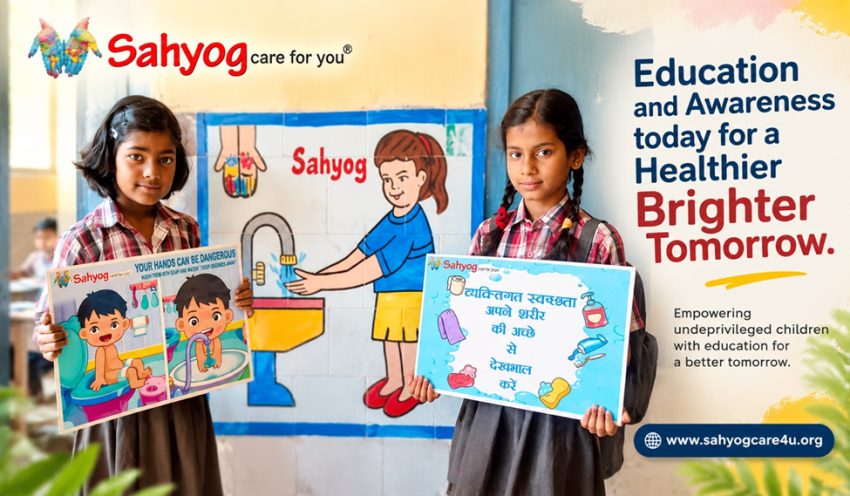
A school day ends at 3 PM. But for a child without a quiet place to read, a classroom that actually works, or anyone to explain a tricky math problem twice, the real education often stops right there too.
Sahyog Care for You, an NGO for child education working across India since 2002, has spent over two decades asking a simple question: what does a child’s day look like after the school bell rings — and what happens if that hour matters just as much as the ones spent in class?
The answer is a four-pillar model, each one solving a different piece of the puzzle: broken classrooms, empty libraries, children left out of the system entirely, and the academic gaps that quietly turn into dropped-out futures.
Pillar One: Fixing the Room Before Fixing the Lesson
You can’t teach a child to dream big in a classroom with a leaking roof and no working lights. That’s the starting point for Smart Shala, Sahyog Care for You’s classroom transformation programme — and it treats a classroom renovation as a complete rebuild, not a cosmetic fix.
The intervention typically covers waterproofing, structural repairs, better lighting and ventilation, restored furniture, smartboard systems with audio support and warranty coverage, BALA (Building as Learning Aid) murals that turn even the walls into teaching tools, and — critically — teacher training, so the technology doesn’t sit unused once the installation team leaves.
From the classrooms of the Kashmir valley to a government school nearly 3,000 kilometers away in rural Tamil Nadu, Smart Shala now runs in 20 schools across 12 states — spanning Delhi, Haryana, Punjab, and Jammu & Kashmir in the north, down through Rajasthan, Gujarat, Chhattisgarh, Jharkhand, and Madhya Pradesh, to Maharashtra, Tamil Nadu, and Telangana — reaching an estimated 16,000 children.
Pillar Two: Handing a Child a Reason to Stay After School
A library doesn’t just raise reading scores — it hands a child quiet permission to imagine a life bigger than the walls around them. That’s the philosophy behind Kitab Ghar, Sahyog Care for You’s school library initiative, which takes forgotten, unused corners of schools and turns them into places children choose to be.
Two Kitab Ghar centers are currently running inside government schools in Gurugram, each stocked with over 1,000 books and reaching roughly 500 students. These aren’t just bookshelves — each space includes reading corners, computers, projectors, and curated collections spanning storybooks, encyclopedias, and curriculum-aligned materials in multiple languages. Teachers and community volunteers are trained in library management and reading promotion, with ongoing mentorship so the space stays alive long after setup, not just for a ribbon-cutting photo.
Pillar Three: Making Sure No Child Is Left Outside the Story
An equal chance at education looks different for every child. For a blind child, it looks like a keyboard under their fingers. For a child with autism, it looks like a screen they can navigate at their own pace. Saksham Shala, Sahyog Care for You’s Inclusive Education initiative, is built around that idea — meeting children with disabilities exactly where they are, instead of asking them to adapt to a system that was never built for them.
The work currently spans three initiatives, all serving children under 18: a computer lab inside a government school in Chhattisgarh with 800 to 900 students, where children with special needs learn alongside their peers rather than apart from them; a program for the children of Delhi Police personnel who are autistic, have speech disorders, or are physically handicapped; and a dedicated Braille classroom in Delhi, where blind children are learning basic computer skills — proof that sight was never a prerequisite for digital literacy.
Pillar Four: Catching the Gap Before It Becomes a Lost Year
Walk into one of Sahyog Care for You’s remedial centers on a weekday evening, and you’ll find children who’ve already sat through a full school day, back at their books anyway — this time with someone beside them willing to explain a tricky sum twice, or read a paragraph aloud until it finally clicks.
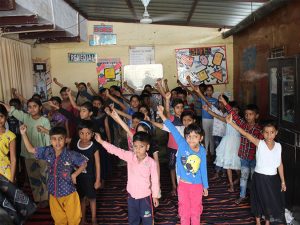
Remedial Education runs for children in Classes 2 to 8, aged 6 to 14, across three centers in Delhi — Mangolpuri, Nihal Vihar, and Nilothi — operating without pause since 2002. Over 2,500 children have sat at these tables in that time, with parents kept in the loop through regular Parent-Teacher Meetings.
Alongside it runs Bal Panchayat, a children’s own leadership council, where kids elect a Treasurer, a Secretary, and office-bearers from among themselves — often the first time anyone has handed them real responsibility. When a hand pump breaks or a road floods every monsoon, it’s frequently the Bal Panchayat that raises it with local administration. When a friend stops coming to school, the group doesn’t wait for a teacher to notice — they walk to that child’s home themselves and make the case for why their friend belongs back in class.
The Fifth Habit Hiding Inside the First Four
Running quietly alongside all four pillars is a Financial and Digital Literacy program built specifically for children — teaching savings, expenses, and the piggy banking method early, so a child’s first coin comes with a lesson in what it can become. Sessions also cover basic taxation, financial safety, and awareness of government schemes meant for children — habits far easier to build young than to unlearn later.
Why This Model Actually Works
What ties these four pillars together isn’t coincidence — it’s design. A renovated classroom means little if a child can’t read beyond the textbook. A library means little if the child it’s built for has already dropped out. And none of it reaches a child with a disability unless someone specifically builds a door for them too. Sahyog Care for You treats these as one connected system, not four separate charities competing for the same child’s attention.
Across all four pillars combined — Smart Shala, remedial classes, and Kitab Ghar alone — the reach now touches an estimated 20,000 children across 14 states.
What to Look for in an NGO for Child Education?
If you’re evaluating an NGO for child education to support, the real test isn’t how many schools appear in a brochure — it’s whether the model accounts for the child who needs extra teaching hours, the one who needs a reason to love reading, and the one who needs a classroom built around their disability, not in spite of it. Sahyog Care for You’s four-pillar structure is built exactly around that completeness.
And if you’re specifically looking for an NGO in Delhi doing this work on the ground — not just funding projects from a distance — the remedial centers in Mangolpuri, Nihal Vihar, and Nilothi, the Braille classroom, and the Bal Panchayat councils are proof of a presence that’s been showing up in the same neighborhoods, year after year, since 2002.
A child’s education was never going to be solved by one classroom alone. It takes a working room, a library worth walking into, a seat held open for every child regardless of ability, and someone willing to explain the hard sum twice. Sahyog Care for You has spent over two decades building all four — one school, one shelf, one child at a time.