
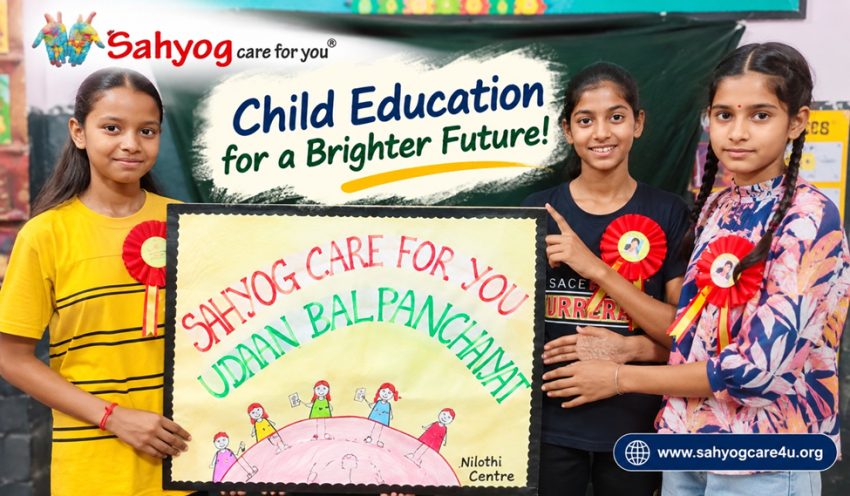
A child doesn’t fall behind all at once. It starts with one fraction that didn’t quite make sense, one paragraph that was read too fast, one lesson that moved on before the child was ready. Left alone, those small gaps quietly stack up into a school year’s setback, and eventually into a child who stops believing school is meant for them.
Sahyog Care for You, an NGO for child education working across India since 2002, built its Remedial Education & Bal Panchayat program around a simple idea: catch the gap early, and it never has to become a lost year.
What the Program Is
Remedial Education & Bal Panchayat is Sahyog Care for You’s after-school academic support program for children in Classes 2 to 8, aged 6 to 14. It exists to make sure that what a school day misses don’t stay missed.
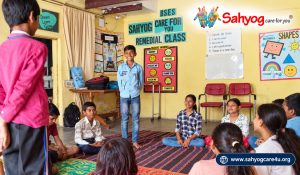
The program has two parts that work together. The first is the remedial center itself, where children get extra academic support once regular classes end. The second is Bal Panchayat, a children’s leadership council that teaches them to take responsibility for their community, and for each other.
Inside a Remedial Centre
Walk into one of these centers on a weekday evening and the scene is quietly remarkable. These are children who have already put in a full school day, yet they’re back at their books. The difference is that someone is now sitting beside them, someone with the time to explain a tricky sum twice, or read a paragraph aloud until it finally makes sense.
That patience is the heart of the program. A crowded classroom can’t always stop for one child who didn’t follow. A remedial center can.
Here’s what defines the way these centers work:
- Every subject is covered, so children aren’t left struggling in one area while the rest of their studies move ahead
- Parents stay involved through regular Parent-Teacher Meetings, keeping families informed and invested in their child’s progress
- Festivals are celebrated together, because learning sticks best when it happens inside a sense of community, not just inside a textbook
Three Centers, Over Two Decades
Sahyog Care for You runs three remedial centers in Delhi, at Mangolpuri, Nihal Vihar, and Nilothi. They have operated without pause since 2002, and over 2,500 children have sat at these tables in that time.
That consistency matters more than it might seem. Education support that appears for a season and disappears leaves children right where they started. Centers that keep their doors open year after year become part of a neighborhood, trusted by families who know the same teachers will be there next term.
Each child who passes through is a small proof of the program’s central belief: a gap caught early never has to turn into a year lost.
Bal Panchayat: Where Children Run the Room
If the remedial center builds academic confidence, Bal Panchayat builds something harder to teach: the instinct to lead.
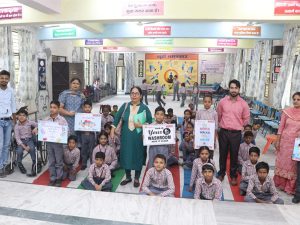
Bal Panchayat is a children’s own leadership council, and the children who join it don’t just attend. They run it. Members elect a Treasurer, a Secretary, and other office-bearers from among themselves, and for many of them, it’s the first time anyone has handed them real responsibility.
That responsibility isn’t symbolic. It shows up in two very concrete ways.
Speaking Up for the Neighborhood
When a community faces a problem, whether it’s a broken hand pump, a water shortage, or a road that floods every monsoon, it’s often the Bal Panchayat that first sits down to talk it through. Then they do something most children never get the chance to do: they walk into the local administration’s office and raise the issue themselves, learning to speak up for their neighborhood the way adults do.
Bringing a Friend Back to School
The second example may be the most powerful. When a friend stops coming to school, the group doesn’t wait for someone else to notice. They go to that child’s home themselves, sit with the parents, and gently make the case for why their friend belongs back in class.
It’s this instinct, to notice, to act, and to bring someone back into the fold, that makes Bal Panchayat one of the most quietly powerful parts of everything Sahyog Care for You does. A dropout is often caught not by a system, but by a classmate who simply cared enough to knock on a door.
Why Pair Tutoring with Leadership?
On paper, extra classes and a children’s council might seem like two unrelated ideas. In practice, they feed each other.
A child who understands her lessons gains the confidence to speak up. A child who has learned to speak up, to hold an office and represent her neighborhood, carries that confidence back into the classroom. Academic support fixes what a child knows; Bal Panchayat shapes what a child believes she can do. Together, they build a generation of kids learning not just to pass a lesson, but to lead their own community.
What to Look for in Remedial Education Work?
Evaluating organizations in this space, a few questions separate real programs from brochures. Does the program cover every subject, or only exam topics? Are parents genuinely involved, or only informed at the end of the year? Has it stayed consistent over time, or does it appear in bursts?
By those measures, a credible NGO for child education is one that treats the hours after school as seriously as the hours during it, and that sees children not just as learners to be taught, but as future leaders to be trusted.
For anyone seeking an NGO in Delhi doing this work on the ground rather than from a distance, the centers in Mangolpuri, Nihal Vihar, and Nilothi stand as an example of what long-term presence looks like: the same neighborhoods, the same commitment, and over 2,500 children supported since 2002.
The Bottom Line
The extra hour after school is easy to overlook. It doesn’t come with a ribbon-cutting or a glossy inauguration. But for a child quietly slipping behind, it can be the difference between a gap that closes and a year that’s lost.
Through remedial centers that explain the hard sum twice, and a Bal Panchayat that teaches children to knock on a friend’s door, Sahyog Care for You is making sure that difference is one no child has to face alone.