
The Blackboard That Never Changed
Some government school classrooms look exactly the way they did twenty years ago — a blackboard, chalk, and a teacher talking through a lesson students can only follow by listening and copying. Meanwhile, the world these students are being prepared for runs on screens and interactive tools, from the college applications they’ll eventually fill out to the jobs they’ll eventually apply for. Closing that gap doesn’t require reinventing the classroom from scratch. It starts with a single, concrete unit: the smart board itself.
Why The Board Itself Changes The Lesson
A diagram that’s drawn once on a blackboard and erased is gone the moment the next topic starts. A concept shown on a smart board can be paused, replayed, or broken into an interactive quiz that tells a teacher immediately which students are following and which aren’t. For subjects like math and science, where a static drawing often can’t keep up with the concept it’s trying to explain, that difference alone changes how much of a lesson actually sticks. It’s not a cosmetic upgrade — it changes the pace at which a class can actually learn.
Csr Smart Board Installation: A Unit Companies Can Actually Fund

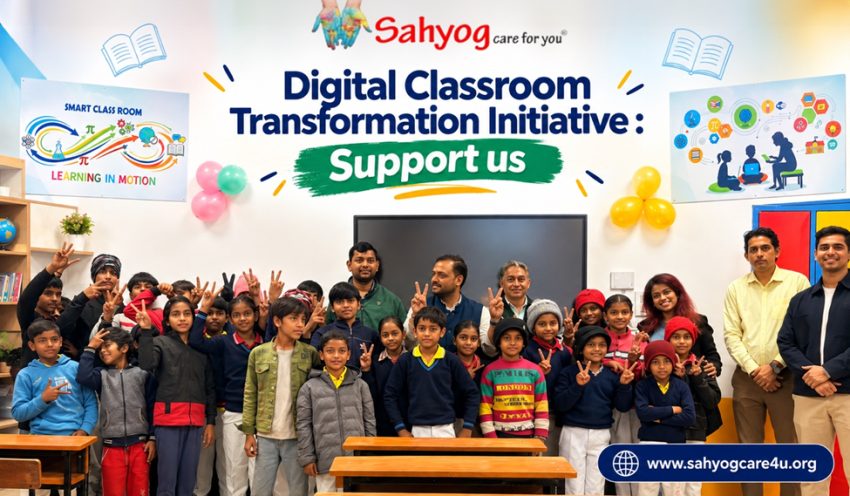
As part of its CSR Smart Board Installation work, Sahyog Care for You’s Smart Shala initiative has already brought smart boards into 20 government schools across Delhi-NCR and Haryana. For a company structuring its education CSR budget, this is about as measurable as a contribution gets — a specific classroom, a specific board, a specific school that didn’t have one before. There’s no ambiguity about where the funding went or what changed because of it, which is exactly the kind of traceable, reportable outcome CSR teams need when they’re accounting for where a budget actually landed. Unlike a scholarship fund or a general donation, a smart board installation can be photographed, visited, and pointed to directly — a concrete answer to the question of what an education CSR budget actually bought.
Ngo For Digital Classroom: What Happens After The Board Goes Up
A smart board mounted on a wall doesn’t teach itself. As an NGO for Digital Classroom effort, Sahyog pairs each installation with digital content, quizzes, and interactive learning tools that turn a one-way lecture into something students actually respond to in real time. None of thi.s replaces the teacher — it gives them a second way to explain something that isn’t landing the first time, and a way to check understanding without waiting for a test at the end of the week. The follow-through shows up in the numbers: better student engagement, stronger academic performance, and fewer dropouts.
Part Of A Larger Digital Push
A single installed board is a good start, but it means more as part of a wider commitment. Smart Shala isn’t a one-off pilot dropped into a handful of showcase classrooms — it’s the same rollout repeated across 20 schools, with the explicit goal of digital empowerment and inclusive education, not just a technology upgrade for its own sake. Improved engagement and academic performance are the visible results, but the underlying aim is broader: making sure a student’s access to modern learning tools doesn’t depend on which school they happened to be assigned to.
The Teacher’s Side Of The Story
Handing a teacher new technology without showing them how to use it usually means the board ends up switched off by the second month. That’s why Teacher Training Programs (TOT) run alongside every installation, walking teachers through the digital content library, the quiz tools, and the basic troubleshooting they’ll need day to day. For a teacher who’s spent years working with just a blackboard, this isn’t a small adjustment — it’s a genuine shift in how a lesson gets delivered, and it only sticks if the support continues past the first training session.
Why The Two Sides Matter Together
A smart board with no trained teacher standing in front of it is an expensive decoration, and a teacher trained on digital tools with no board to use is stuck waiting. What makes CSR Smart Board Installation funding worth it is the training that follows it, and what makes an NGO for Digital Classroom program work is the hardware that training gets applied to. Neither half does much on its own — together, they’re what actually changes a classroom, not just its equipment list.
Get Involved
Companies structuring their next education CSR allocation can fund a smart board installation and the teacher training that comes with it, giving one more classroom the digital transformation it’s been waiting for — with a clear, reportable outcome to show for it: a named school, a specific classroom, a board that wasn’t there before. Individuals looking to support a specific, visible outcome can sponsor a single classroom’s transformation from blackboard to smart board, start to finish, and see exactly where their contribution went.