
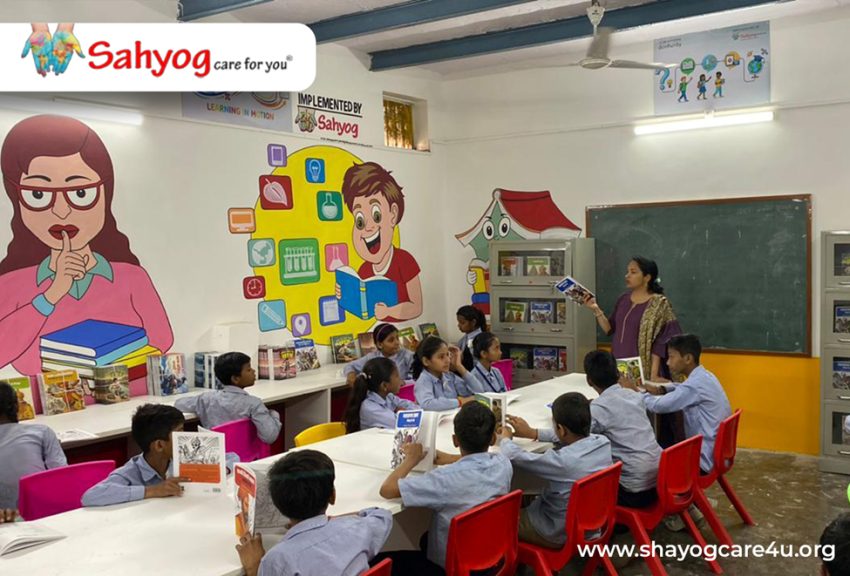
India has connected more people to the internet in the last decade than most countries have citizens. Yet being connected and being equipped to actually use that connection well turn out to be two very different things. A smartphone in someone’s hand doesn’t automatically mean they can fill out a government form online, apply for a job, or help their child with a digital assignment. That gap, between access and genuine capability, is where India’s real digital divide now lives, and it’s a gap that infrastructure alone was never going to close.
India’s Digital Divide, in Numbers
The scale of this gap is well documented. The Comprehensive Annual Modular Survey (CAMS) 2025, conducted by the National Sample Survey Office, found that broadband penetration across India had reached 76.3%, a genuinely impressive figure, but one that sits alongside stark and persistent disparities in actual digital skills. Urban India’s digital literacy rate stands at roughly 61%, compared to just 25% in rural areas, according to research cited by Ideas for India. The gap runs along other lines too: a 2022 Oxfam India report found that while 61% of men owned a mobile phone, only 31% of women did, and caste-based disparities compound the picture further, with digital literacy estimated at around 64% among the general category, falling to 52% for Other Backward Classes, and down to 38% and 31% respectively among Scheduled Castes and Scheduled Tribes.
These aren’t abstract statistics. They translate into real people who own a phone but can’t use it to access a government scheme, children who sit in a classroom with no exposure to a computer until well into their teenage years, and women who are the last in their household to get meaningful, unsupervised access to the family’s one smartphone. Government efforts like the Digital India Mission and the PMGDISHA rural literacy scheme have made real progress on infrastructure and basic awareness, but a national mission of that scale inevitably leaves gaps at the community level, gaps that tend to fall hardest on the same rural, lower-income, and marginalized households the data above already points to.
Digital Literacy Is More Than Just Owning a Device
It’s tempting to treat digital inclusion as solved the moment a SIM card and a cheap smartphone reach a household. In practice, ownership without capability tends to just shift the problem rather than solve it. Genuine digital literacy means being able to search for reliable information, use basic office and communication tools, understand enough about online safety to avoid scams, and confidently apply digital skills toward employment or further learning. Closing this gap takes sustained, hands-on training, not a one-time device handout, and that kind of consistent groundwork is usually where a dedicated NGO for digital inclusion ends up doing the heaviest lifting, often filling gaps that government infrastructure alone hasn’t yet reached.
How Sahyog Care for You Approaches Digital Inclusion
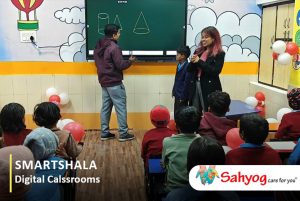
Sahyog Care for You has built its response around two connected fronts, starting young and continuing into adulthood, rather than treating digital capability as a problem that belongs to just one age group or one part of a family. For children, the organisation’s Smart Shala initiative has already brought technology-enabled classrooms, complete with smart boards, digital content, interactive quizzes, and other learning tools, to 18 locations across India, reaching over 2,490 students. Alongside the hardware, teachers themselves are trained through dedicated Teacher Training Programs, ensuring digital tools actually get used well in daily lessons rather than sitting idle once installed, which is often where similar initiatives elsewhere quietly stall.
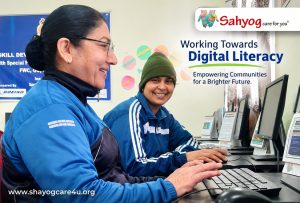
For adults, particularly within military families, veterans, and women looking to rebuild their livelihoods, the organisation runs structured IT and digital skilling programs, covering everything from basic computer literacy to more advanced courses in AI, DTP, Tally, web design, graphic design, and programming, alongside BPO training for those seeking a faster route into structured employment. This work reflects what a genuine NGO for digital literacy looks like in practice, one that treats a course completion certificate as a starting point toward real employment, not an end in itself, and that follows up with career guidance and placement support rather than considering the job finished once the classes end.
Why Treating This as One Connected Mission Matters
What makes this approach effective is that it doesn’t stop at children or adults alone, it treats digital capability as something that needs building at every stage of life, and across every member of a household. A child who grows up comfortable with a computer in a Smart Shala classroom, and a mother in the same family who later gains confidence through an IT skilling course, represent two ends of the same underlying problem being solved together rather than separately, which is really what a serious NGO for digital inclusion should look like on the ground. This is the kind of layered, sustained commitment that separates genuine progress from a single donated batch of laptops that quietly gathers dust within a year.
For schools, families, and communities looking for support that goes beyond one-off device distribution, this combination of early digital exposure and adult-focused skilling reflects what serious, ongoing work in this space actually requires: training that continues well after the initial rollout, and a willingness to measure whether people are genuinely using these skills, not just whether they once attended a session.
Get Involved
Reaching more children, more women, and more families with this kind of sustained digital training takes continued support, and it’s exactly the kind of ongoing work a committed NGO for digital literacy exists to do. Whether it’s funding a new Smart Shala classroom, sponsoring an adult skilling cohort, or simply volunteering time to help run a session, every contribution moves someone a little closer to using technology confidently rather than just owning it. Closing India’s digital divide will take exactly this kind of patient, ground-level work, carried out consistently, one classroom and one course at a time.