
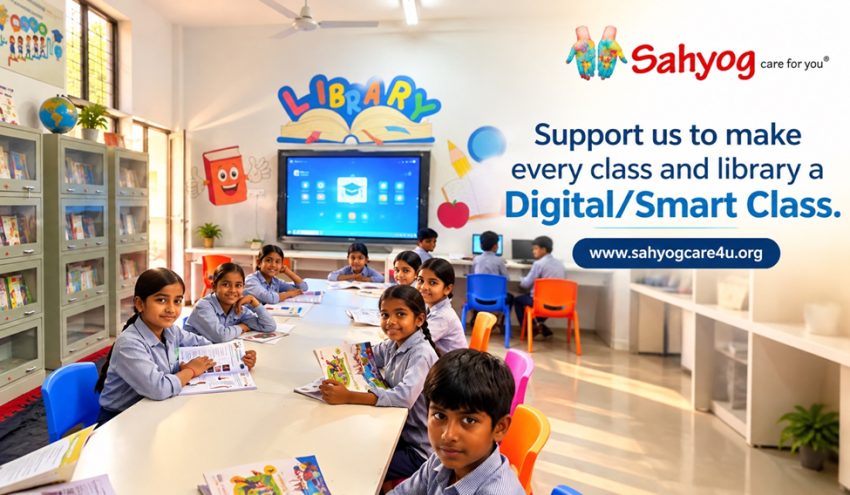
THE OPPORTUNITY
Every CSR committee eventually asks the same question: where does this rupee actually go the furthest? Education funding often gets spent on things that are easy to photograph, a donated laptop cart, a ribbon-cutting at a new building, but hard to measure a year later. Digital education is the rare category where the opportunity and the evidence line up, a cause with both a clear social need and a genuinely trackable return.
THE MARKET PROBLEM
The market gap here is large and well documented. Government data from UDISE+ shows that around half of India’s schools still lack access to basic modern educational technology, and in rural areas specifically, only about 28% of government schools have functional internet access. The COVID-19 pandemic made the cost of this gap painfully clear: a nationwide study found that a large majority of children in government schools received no learning materials at all during lockdown periods, while better-resourced schools shifted to digital platforms with comparatively little disruption. That’s a market failure in the truest sense, demand for modern learning tools vastly outstrips supply, and the gap compounds every year it goes unaddressed, with each uncovered cohort of students entering the job market a step further behind their better-resourced peers.
PROOF OF CONCEPT
Skeptical that technology actually moves the needle on learning outcomes? The data says otherwise, decisively. In one government girls’ school in Bihar’s Gaya district, introducing AI-assisted, tablet-based language apps helped English literacy levels jump from just 32% to 71% within a single year. That’s not a modest improvement, it’s proof that the right technology, placed in the right classroom, with a teacher who knows how to use it, can move outcomes faster than almost any other education intervention on the table.
THE PRODUCT
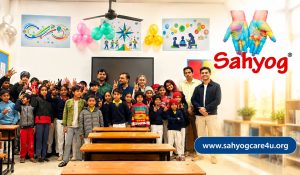
This is where Sahyog Care for You’s SmartShala model comes in, and it’s built specifically to replicate results like Gaya’s rather than hope for them. Rather than simply installing a smartboard and walking away, the programme rebuilds the classroom around it: waterproofing, ventilation, and structural repairs where needed, BALA murals that turn walls into learning aids, restored furniture, and dedicated teacher training so the technology gets used well from day one. This complete-package approach is exactly what separates a genuine NGO for Digital Education from a vendor simply fulfilling a hardware order, the classroom, the teacher, and the technology are treated as one investment, not three separate line items.
TRACTION
A pitch is only as good as its traction, and this one already has it. SmartShala has reached 14 states across India, from Jammu & Kashmir to Tamil Nadu, supporting an estimated 16,000 children in government schools. That’s not a single pilot classroom held up as a proof of concept, it’s a repeatable, multi-state rollout that’s already proven it holds its quality whether it lands in a border state or a coastal one.
WHY THIS IS THE RIGHT INVESTMENT CATEGORY
For a CSR committee comparing causes, digital education offers something genuinely rare: outcomes that are both meaningful and measurable. A smartboard installed, a classroom renovated, a teacher trained, a literacy score that moves, each of these can be tracked and reported with a level of specificity that satisfies both compliance requirements and genuine curiosity about impact. This is exactly why a well-structured Technology-Based CSR project in this space tends to outperform funding scattered across causes where outcomes are harder to pin down or report on with real numbers. Compare this to a generic donation where the only metric available a year later is the cheque amount itself, there’s simply no equivalent way to show a funder what actually changed. Sahyog Care for You’s model offers precisely this kind of structure, a scalable, trackable rollout rather than a one-off gesture that’s difficult to evaluate a year later.
RISK AND MITIGATION
Every pitch needs to address risk honestly. The biggest risk in education-focused giving is hardware that goes unused once the cameras leave, a smartboard with no trained teacher behind it rarely changes outcomes at all, no matter how advanced the equipment is. SmartShala mitigates this directly by building teacher training into every rollout from the start, not as an optional add-on, which is precisely why its results hold up across states rather than fading after the first semester. A second risk worth naming is geographic concentration, many well-intentioned programmes quietly cluster around a handful of easy-to-reach cities, leaving the rest of the country untouched. SmartShala’s spread across 14 states, including locations far outside the usual metro circuit, is itself a form of risk mitigation, proof that the model doesn’t depend on being near a major city to function well.
THE ASK
Extending this model to more classrooms takes continued investment. Funding a SmartShala classroom renovation, sponsoring a smartboard installation, or backing the teacher training that makes the technology stick, each is a concrete, trackable unit of impact rather than an open-ended donation. Companies and donors specifically searching for a proven NGO for Digital Education partner with real traction behind it will find exactly that kind of evidence here. And anyone structuring their next Technology-Based CSR project around outcomes they can actually report on need only look at Sahyog Care for You’s track record across 14 states before signing off.
THE RETURN
The return on this investment isn’t abstract. It’s a literacy score that moves from 32% to 71% in a year. It’s a classroom in a border state running on the same standard as one on the coast. It’s 16,000 children who now have access to the kind of learning tools their peers in better-resourced schools have had for years. Few CSR categories offer this much clarity on what the money actually buys, and fewer still can show it’s already working.