
SAMPLE: Drinking water supply, rural India QUESTION UNDER TEST: Is a tap connection the same thing as safe water?
Ask most people whether a village has water, and they will count taps. A better question is what comes out of them. Here is a report that tests India’s drinking water on the parameters that matter, starting with the government’s own numbers.
Parameter 1: Coverage. Result: Strong Progress
India’s Jal Jeevan Mission, launched in August 2019, aims to give every rural household a functional tap connection delivering 55 liters per person per day to the Bureau of Indian Standards quality norm (BIS 10500). When it began, only 3.23 crore rural households, about 16.7%, had tap connections. By 18 July 2026, around 15.89 crore of India’s 19.36 crore rural households, or 82.09%, were reported to have tap water in their homes. That is a remarkable expansion in under seven years, and Jal Jeevan Mission 2.0 aims to extend tap water to all rural households by December 2028.
Parameter 2: Reliability. Result: Partial
A tap that runs only sometimes is only part of a solution. In the mission’s 2024 functionality assessment of surveyed villages, 87% of households with tap connections reported receiving water in the previous week, 84% received it on schedule, and 80% received the minimum 55 litres per person per day. These are strong numbers, and they also show that roughly one in five households with a tap still falls short on quantity.
Parameter 3: Quality. Result: Needs Attention
This is the parameter that decides whether water is safe, and it is where the report gets harder to read. The same 2024 assessment found 76% of households free from bacteriological contamination and 81% of supply sources free from chemical contamination. In other words, a connection does not guarantee clean water. A household can have a tap and still be exposed to germs or chemicals, particularly where groundwater is the source or where pipes and storage are poorly maintained. Groundwater supplies a large share of rural India’s drinking water, and in several states it carries natural contaminants such as fluoride, arsenic, and nitrate that neither a pipe nor a tap can remove. Treatment at the point of use is often the only reliable fix. Roughly 3.5 crore rural households were also still waiting for a connection altogether.
Parameter 4: Health Outcomes. Result: The Cost Of Getting It Wrong
The reason these percentages matter is people. Government surveillance data records more than 30 million cases of waterborne disease in India every year, including diarrhoea, typhoid, and cholera. The World Health Organization estimates that unsafe water, sanitation, and hygiene contribute to close to 300,000 deaths a year in India, with children under five bearing a disproportionate share. Most of these are preventable. The gap is rarely a lack of knowledge about the cure. It is a lack of safe water within reach.
Recommended Treatment: Project Jal Raksha
This is where Sahyog Care for You comes in. Project Jal Raksha installs RO water facilities in schools and communities that lack reliable access to safe drinking water. So far, 39 water RO facilities have been installed across 13 states, Maharashtra, Himachal Pradesh, Tamil Nadu, Madhya Pradesh, Telangana, Haryana, Jharkhand, Karnataka, Punjab, Delhi, Rajasthan, Gujarat, and Andhra Pradesh, alongside a Water Kiosk model. Together they reach 2,47,500 beneficiaries. Safe water is also part of Sahyog’s health work: water RO systems have been installed at Primary Health Centers, so that patients and the staff who care for them have something as basic as clean drinking water on site.
In schools, RO and UV systems ranging from 500 to 1,200 liters per hour are installed according to each site’s needs, so that children have clean water where they spend their day. Where the quality parameter is the problem, this is a direct response: water is treated at the point of use, and the community gets a source it can trust.
Dosage: A Water Atm For ₹1
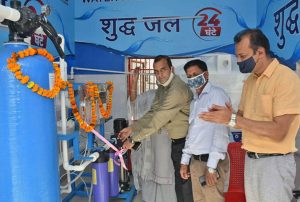
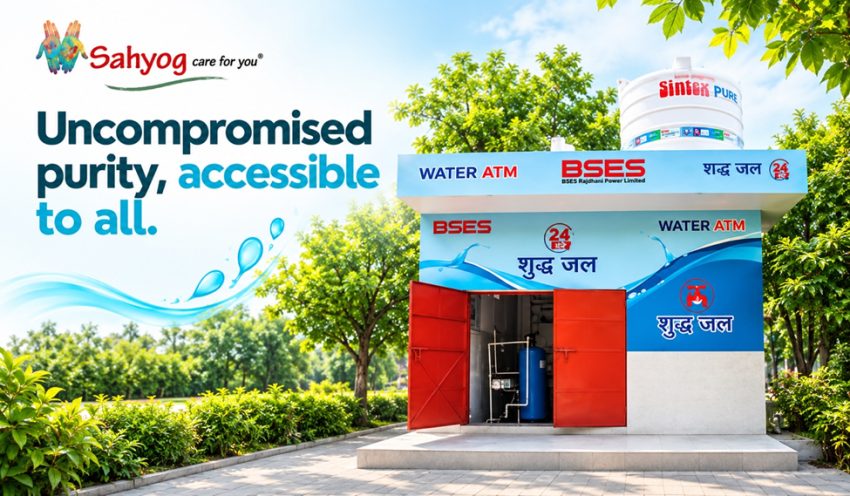
Some of these RO units are converted into Water ATMs, run by local women’s Self Help Groups. A person inserts a coin or taps an RFID card, and the machine dispenses 10 litres of safe drinking water for ₹1, making clean water a daily habit rather than an occasional luxury. Each ATM also creates local employment, typically for 3 to 4 women, who earn around ₹6,000 to ₹7,000 a month managing it, putting women at the center of running the service instead of only receiving it.
Quality Assurance: Built In, Not Bolted On
A treatment is only as good as its upkeep. Each plant comes with a 12-month warranty and quarterly maintenance visits, with regular water quality checks by the Delhi Jal Board and other government agencies. Awareness sessions on safe water handling, storage, and conservation run alongside every installation, because clean water can be contaminated again between the machine and the glass. Reliability and quality, the two parameters that fall short in the national numbers, are the two the model is designed around.
Where To Collect A Sample
Anyone looking for a reliable NGO for safe drinking water can read the footprint above: thirteen states, schools and communities, and a record that includes quality checks and maintenance. And for the many people who simply type NGO near me into a search bar, the practical answer depends on where they are. Sahyog Care for You’s installations stretch from Delhi to Tamil Nadu and Himachal Pradesh to Gujarat, so a facility may be closer than expected.
Conclusion
India has made remarkable progress in getting water to homes. The next test is whether that water is safe, reliable, and within reach of the families still waiting. Supporting this work can mean sponsoring a school RO system, backing a Water ATM run by a women’s group, or helping fund the awareness sessions that keep water safe after it leaves the tap. Companies and donors looking for an NGO for safe drinking water with measurable results will find them in the numbers above. And anyone asking for an NGO near me that treats water as a daily service, not a one-time installation, can start with the nearest Water ATM and ask who maintains it.