
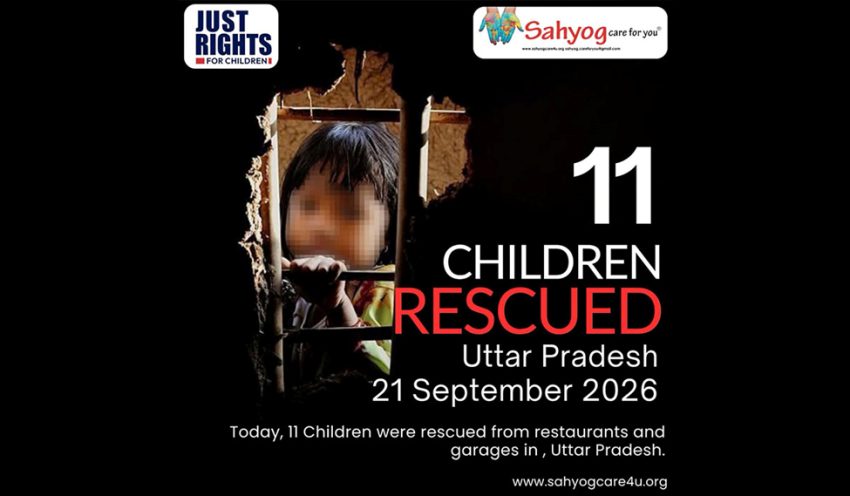
Somewhere in a factory or workshop in Delhi or Uttar Pradesh this August, a child was working a 12 to 15 hour shift for less than ₹300 a day. By the end of the month, 76 children in situations like that one was no longer working them.
The Situation On The Ground
Child trafficking and labour remain a serious, ongoing problem in India. Children are illegally moved from states like Bihar, Jharkhand, Jammu and Kashmir, and Uttar Pradesh into cities where they’re forced into labour or other abusive situations, often as bonded labourers earning an average of ₹150 to ₹300 a day for work that can run 12 to 15 hours. Most end up there because of family pressure or sheer economic desperation, not because anyone chose this for them, and not because their families necessarily understood what conditions they were being sent into. Every hour spent on a factory floor is an hour taken from a classroom, and for most of these children, childhood itself becomes something they lose long before they understand what was taken. The longer a child stays in these conditions, the harder it becomes to reverse the damage, to education, to physical health, and to the basic sense of safety every child is owed.
The Raid
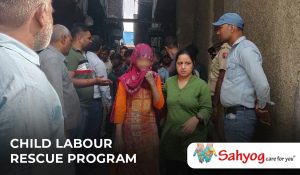
Sahyog Care for You runs rescue operations directly in the industrial areas and factories across Delhi, Uttar Pradesh, and Haryana where this exploitation happens, working alongside police enforcement, the SDM, the Labour Department, and the Child Welfare Committee to identify and liberate children from these conditions. This isn’t work that can be done by a single organization acting alone, it requires coordinated legal authority, the kind only these government bodies can provide, paired with the on-ground intelligence and follow-through an organization embedded in these communities brings to the table. Factories found running on child and bonded labour don’t just lose their workforce, they get legally sealed, a consequence severe enough to matter, and one that sends a clear signal that this kind of exploitation carries real legal risk, not just moral condemnation.
August, By The Numbers
Eight raids conducted, all across Delhi and Uttar Pradesh. Seventy-six children rescued in total, 68 boys and 8 girls, every one of them pulled off a factory floor and into safety within a single month. Over four lakh rupees in withheld wages, ₹4,08,058 to be exact, recovered and returned to the children who had earned it, wages that had been kept from them under exactly the kind of exploitative arrangement bonded labour depends on. Five factories, found running on child and bonded labour, sealed as a direct legal consequence, removing the specific operations that had been profiting from this exploitation.
Behind each of those numbers is a child who, at the start of August, had no reason to expect anything would change, and by the end of it, had a completely different set of possibilities in front of them.
The Moment A Child Is Free
Rescue is the beginning of the work, not the end of it. Every child brought out of these conditions receives immediate medical care, addressing whatever physical toll months or years of unsafe labour has taken on a body that was never meant to carry it, malnutrition, untreated injuries, exhaustion that’s been allowed to accumulate for far too long. Alongside this, counselling support helps children begin processing trauma that doesn’t disappear the moment they walk out of a factory gate. A child who has spent months or years being told their labour matters more than their wellbeing needs more than a change of location to actually recover, they need consistent, professional support to rebuild a sense of safety and self-worth.
The Work That Continues Long After The Raid
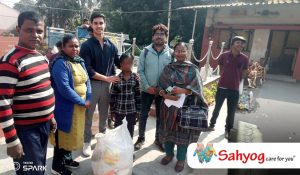
This is where genuine child labour rehabilitation actually happens, in the months that follow, not the day of the rescue itself. Sahyog Care for You’s team stays in continuous contact with rescued children and their families, offering sustained support rather than a one-time intervention that ends once the news coverage does. In the initial months, this includes enrolment in schools, access to vocational training for older children building toward independent livelihoods, and grocery kits, hygiene kits, and stationery kits that address the immediate, practical needs a family often can’t cover on its own right after a rescue. These aren’t small details, a family that rescued a child but still can’t afford groceries or school supplies is a family still under exactly the kind of pressure that led to the exploitation in the first place. A genuine NGO for child rehabilitation has to stay involved well past the headline moment of a raid, because a child handed back into the same economic pressure that led to their exploitation in the first place is a child at risk of being trafficked right back into it.
Why This Number Matters Beyond August
Seventy-six children are one month’s work in two states. The scale of the underlying problem, spanning multiple source states and destination cities across the country, means this kind of sustained, coordinated raid-and-rehabilitation model needs to keep running, month after month, faster than the exploitation it’s working against. A single successful month doesn’t close the gap, it’s evidence that the model works and needs to be sustained and expanded, not treated as a one-off success to point to.
Get Involved
Supporting this work means funding medical care and counselling for rescued children, sponsoring school enrolment and vocational training, or contributing toward the grocery, hygiene, and stationery kits that help a family stabilize in the months right after a rescue. For anyone looking to fund genuine child labour rehabilitation rather than a single rescue moment, or searching for an NGO for child rehabilitation with a documented, month-by-month track record, this is exactly the kind of sustained work worth backing. Every raid conducted, every child freed, and every factory sealed depends on this continuing, consistently, for as long as the problem does, and every contribution helps ensure August’s numbers aren’t a high point that fades, but a baseline the work keeps building on.