
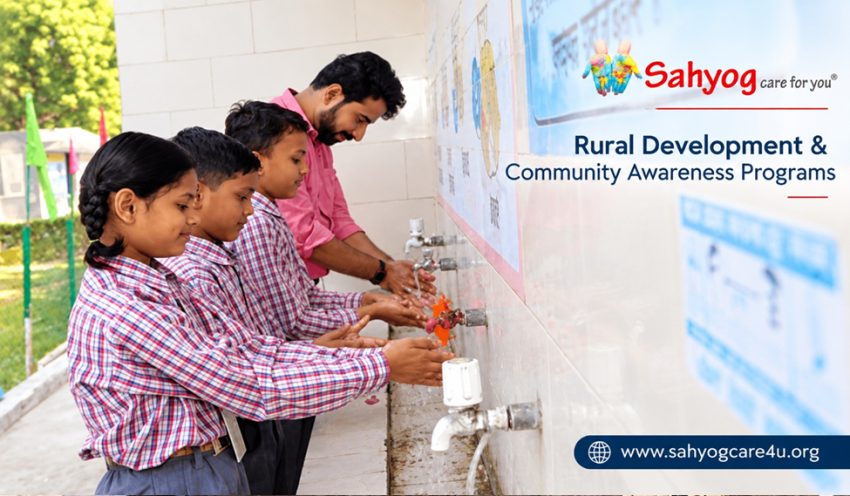
Anyone who has played Jenga knows the feeling. The tower stands steady for a while, then someone slides out one block, and the whole thing starts to lean. Rural India works much the same way. More than 60% of India’s 1.4 billion people live in its villages and small towns, and for them, a community stays upright only as long as every block is in place. Remove a single one, and the pressure lands on whoever has the least room to absorb it, usually a child.
Sahyog Care For You builds its rural work around six of these blocks. Here is what each one holds up, and what happens when it goes missing.
Block One: A Toilet That Works
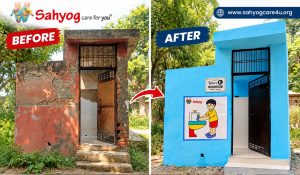
Pull this block out, and a girl stays home from school. It is rarely a dramatic decision. There is simply nowhere clean, private, and safe to go, so attendance quietly slips and, over time, so does her education. Under The Dignity Project, Sahyog Care for You has renovated toilets across more than 650 government schools and communities. The focus is as much on upkeep as on construction, with caretakers trained to keep facilities clean and in daily use, because a toilet built once and left alone tends to fall into disrepair within a year or two.
Block Two: Water You Can Trust
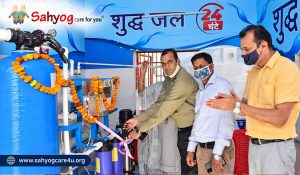
Pull this block, and a family ends up choosing between safe drinking water and the rest of its budget. Project Jal Raksha answers that with over 39 RO installations reaching 2,47,500 beneficiaries, with RO and UV systems sized to the needs of each school or community site. Some of these units are converted into Water ATMs run by women’s Self Help Groups, dispensing 10 liters of safe water for ₹1 and giving the women who manage them a local income. Access to clean water and a livelihood arrive in the same machine. Installing a facility is only half the work, so the programme also runs sessions on safe water handling, storage, and conservation, which is what keeps an installation useful long after the day it is switched on.
Block Three: Power That Stays On

Pull this block, and the village square empties after sunset, while classrooms go dark the moment the grid fails. Solar-Driven Development brings solar power and lighting to schools and villages with limited electricity access. Solar panels now run in government schools across Faridabad and Gurgaon, cutting electricity costs and keeping classrooms lit through power cuts, while solar street lights in villages like Dhule in Maharashtra have restored after-dark safety, so women and children can be outside after dark without fear. Each installation follows a clear sequence of site assessment, certified installation, and staff training, and together these projects help avoid roughly 50 metric tons of CO₂ a year, comparable to the annual absorption of about 2,100 mature trees.
Block Four: A Classroom Worth Sitting In
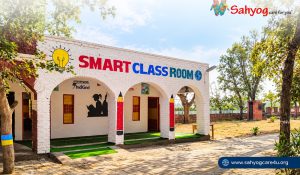
Pull this block, and the best-intentioned technology ends up in a damp room nobody wants to use. Smart Shala rebuilds government school classrooms from the ground up: waterproofing roofs, fixing lighting and furniture, and only then installing smartboards, and only once teachers have been trained to use them. The programme is now present across 14 states, from Jammu & Kashmir to Tamil Nadu. The order matters. A smartboard on a leaking wall, in front of a teacher who was never shown how to use it, rarely changes anything. A repaired room and a trained teacher almost always do.
Block Five: A Reason To Stay Curious
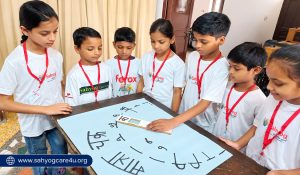
Pull this block, and a classroom teaches children to pass exams but gives them little reason to read for pleasure. Kitab Ghar renovates and stocks school libraries with books across all categories, and trains staff to keep children coming back on their own. Many schools report having a library on paper, but a locked cupboard of outdated textbooks is not a library. A renovated room, stocked with books children actually want to read, is.
Block Six: The One That Holds The Rest In Place
This block rarely gets a photograph, and it is the one that stops the tower from leaning. Ribbon-cuttings are easy to document. A change in how a village thinks about hygiene, water, or its own children’s education is much harder to capture, and much more valuable. Community Awareness Programmes carry hygiene and behavior-change sessions into villages, delivered in the local language, so people understand why a clean toilet, a safe tap, or a lit street matters and how to look after it. A facility handed over without that conversation is often underused or neglected. With it, the habits outlast any single project. This is the core of what a genuine NGO for Community Development actually does: it builds both the structure and the shared understanding that keeps it standing.
What The Tower Looks Like When All Six Are In Place
A child no longer misses school because there is nowhere clean to go. A family stops weighing safe water against everything else it needs to buy. A classroom stays lit and running through a power cut instead of going dark along with everything else. A village square that used to empty after sunset stays alive. None of these changes is dramatic on its own. They are small, specific shifts, and together they raise the standard of living one school and one community at a time.
This is also why a single-issue approach so often disappoints. A toilet without water is unusable. A smartboard without power is a blank screen. A library in a school with no electricity is a dim room. Rural problems do not arrive one at a time, so they cannot be solved one at a time. That is what separates a genuine NGO for Rural Development from a programme that delivers a single, photogenic project and moves on.
Keeping The Tower Standing
The tower only grows if more people help build it. Funding a toilet renovation, a water facility, a solar installation, a Smart Shala classroom, or a school library are all concrete ways to place another block. Companies and donors looking for an NGO for Rural Development with a record they can check will find it in the numbers above. And anyone searching for an NGO for Community Development that pairs infrastructure with the awareness to make it last can start with the blocks already in place, and ask which ones their own village is still missing.