
A tap gets installed. A ribbon is cut, photos are taken, a report is filed. Six months later, the tap is dry, the pump is broken, and nobody knows whose job it is to fix it.
That scene is why the word implementation matters in water, sanitation, and hygiene (WASH) work. This post looks at the national picture first, then at Sahyog Care for You and how it answers five practical questions about safe drinking water.
The Big Picture: Progress with a Catch
Globally, 2.1 billion people still lack safely managed drinking water, and 3.4 billion lack safely managed sanitation. India has made fast progress on its side of the ledger:
Under the Jal Jeevan Mission, rural tap water coverage has crossed 82 per cent, with 15.89 crore households connected.
- On sanitation, coverage rose from 39 per cent in 2014 to 100 per cent in 2019, after which India was declared Open Defecation Free.
The catch is what happens after installation. An independent 2024 assessment found that 76 per cent of the tap connections provided under the mission were functional, and about 3.54 crore rural households were still waiting for a tap. Building is half the job, and keeping things running is the other half.
The cost of the gap is measured in children’s lives. Looking at the last year with solid published figures, diarrhoea killed 117,285 Indian children under five in 2015, about 10 per cent of all deaths in that age group, from a disease that safe water, sanitation, and hygiene can largely prevent. Those figures are dated, but they show what is at stake when water and toilets fail.
So What Is a WASH Implementation Partner?
Funders and governments set the goals. A WASH implementation partner does the work on the ground: it finds where the need is greatest, builds the infrastructure, trains the people who will run it, and returns to check that it still works.
Here are five questions to test any partner, with Sahyog Care for You’s answers on safe drinking water.
Question 1: Does It Go Where the Need Is?
Through Project Jal Raksha, Sahyog Care for You has installed 39 water RO facilities across Maharashtra, Himachal Pradesh, Tamil Nadu, Madhya Pradesh, Telangana, Haryana, Jharkhand, Karnataka, Punjab, Delhi, Rajasthan, Gujarat, and Andhra Pradesh. Together with a Water Kiosk model, the facilities reach about 2,47,500 beneficiaries, and over 2,53,000 people now rely on the RO facilities for safe drinking water every day.
RO/UV systems in schools range from 500 to 1,200 liters per hour, sized to each site’s needs instead of a one-size-fits-all unit.
Question 2: Is the Water Actually Checked?
Clean water is a promise that needs proof. Each plant comes with a 12-month warranty and quarterly maintenance visits, and the water is tested regularly by the Delhi Jal Board and other government agencies. Independent checks are what separate a working water facility from a decorative one.
Question 3: Can People Afford It, and Does It Stay Local?
Some RO units are converted into Water ATMs, run by local Self-Help Groups. A person inserts a coin or taps an RFID card, and the machine dispenses 10 litters of safe drinking water for ₹1. That price makes safe water a daily habit rather than an occasional luxury.
Every ATM also creates local employment through its daily operations and opens entrepreneurship opportunities that put women at the center of running it, not just receiving from it.
Question 4: Who Keeps It Running?
This is where most projects fail. Sahyog Care for You pairs infrastructure with training for the people who will keep it alive. Around 200 school staff and community caretakers have been trained in upkeep and cleanliness practices.
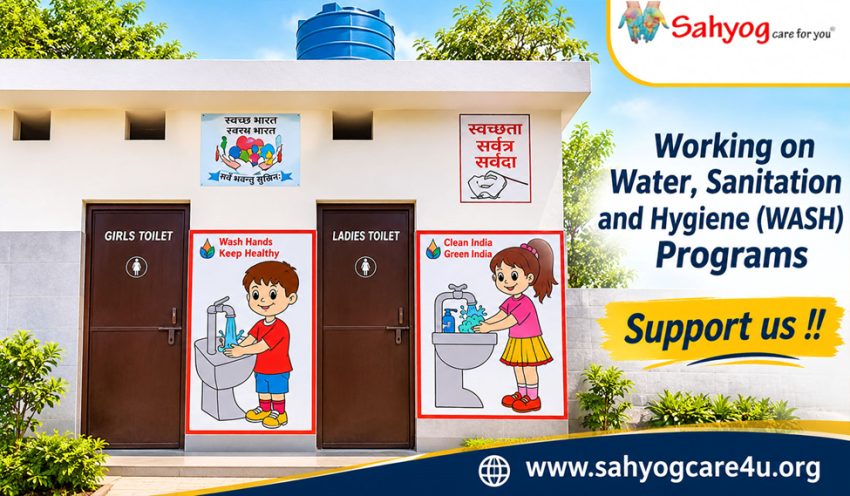
The same philosophy shapes The Dignity Project, which has renovated toilets in over 650 government schools and communities. Its focus is upkeep as much as construction, because toilets built once are too often left unmaintained. The results include improved attendance, especially among adolescent girls, and fewer sanitation-related illnesses in schools and homes.
Question 5: Does It Change Behavior?
Pipes and toilets alone don’t change habits. Through Awareness 360, Sahyog Care for You runs hygiene and behavior-change sessions in schools and communities, along with community sessions on safe water handling, storage, and conservation. WASH sessions have reached 37,000 children across Delhi NCR, and hygiene awareness has reached over 3,25,000 students and community members.
The work also has a track record. In 2017, the Clean 4 Good Campaign in Delhi gave 2,105 underprivileged children aged 6 to 14 haircuts, baths, and handwashing support, and earned a place in the Limca Book of Records.
The Scorecard at a Glance
| What | Number |
| Water RO facilities installed | 39 |
| People relying on RO water daily | 2,53,000+ |
| Toilets renovated (schools and communities) | 650+ |
| School staff and caretakers trained | ~200 |
| Children reached by WASH sessions in Delhi NCR | 37,000 |
Why Local Presence Matters
Maintenance visits, quality checks, and follow-up sessions need people who live close enough to return. For corporates and funders choosing a WASH implementation partner, ask about the maintenance plan before the installation plan. And when the work is in the capital, a credible NGO in Delhi can be held accountable in person, from the Delhi Jal Board’s quality checks to the Self-Help Groups running the ATMs.
How to Support This Work?
- Fund a water RO facility or Water ATM for a school or community without reliable safe water.
- Sponsor a toilet renovation so a child can stay in school.
- Back a hygiene awareness campaign that turns one-time installations into lasting habits.
Clean water is the most basic promise a neighborhood can make to the people inside it. At ₹1 for 10 litters, a committed NGO in Delhi is showing that the promise doesn’t have to be expensive to keep.