
When a company decides to put its CSR budget into water, sanitation, and hygiene, the same questions come up in nearly every committee meeting. Is it allowed? Is the need real? Will it last? Here are seven honest answers, drawing on national data and on the work of Sahyog Care for You.
-
Is WASH an eligible CSR activity?
Yes. Under Section 135 of the Companies Act, 2013, companies with a net worth of ₹500 crore or more, turnover of ₹1,000 crore or more, or net profit of ₹5 crore or more must spend 2% of their average net profit of the preceding three years on CSR. Schedule VII, which lists the eligible areas, includes promoting preventive health care and sanitation and making available safe drinking water. That makes CSR WASH projects a core category, not a side option.
-
Is the need still real, given India’s progress?
The progress is genuine. Under the Jal Jeevan Mission, rural tap water coverage has crossed 82 per cent, with 15.89 crore households connected. On sanitation, coverage rose from 39 per cent in 2014 to 100 per cent in 2019, and India was declared Open Defecation Free. Globally, 2.1 billion people still lack safely managed drinking water, and 3.4 billion lack safely managed sanitation.
The gap that remains is about quality and upkeep. An independent 2024 assessment found that 76 per cent of the tap connections provided were functional. In other words, a significant share of what has been built isn’t working as intended. That is where a CSR rupee can still do the best.
-
Why start with school toilets?
Because the problem shows up first in classrooms. Poor sanitation in schools is one of the most overlooked barriers to education, especially for adolescent girls, who often drop out or stay home when there is no clean, private, safe toilet.
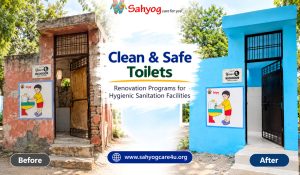
Sahyog Care for You has renovated toilets in 650 government schools, giving thousands of students dignified, hygienic facilities every day. Once the doors opened, school attendance rose noticeably, especially among adolescent girls, many of whom had previously stayed home rather than face the day without access to one.
-
Do renovated toilets stay clean?
Only if someone is responsible for them. Sahyog Care for You has trained close to 200 school staff and community caretakers in maintenance and cleanliness, making them the custodians of what was built so it keeps serving students after the project team has moved on.
Hygiene awareness sessions have also reached over 3,25,000 students and hundreds of community members, backed by visual messaging in schools and repeated sessions in surrounding communities. Schools and homes are now seeing fewer sanitation-related illnesses.
-
What does safe drinking water look like at scale?
Through Project Jal Raksha, Sahyog Care for You has installed 39 water RO facilities across 13 states: Maharashtra, Himachal Pradesh, Tamil Nadu, Madhya Pradesh, Telangana, Haryana, Jharkhand, Karnataka, Punjab, Delhi, Rajasthan, Gujarat, and Andhra Pradesh. Over 2,53,000 people now rely on these facilities for safe drinking water every day. School systems range from 500 to 1,200 liters per hour, sized to each site rather than copied from a template.
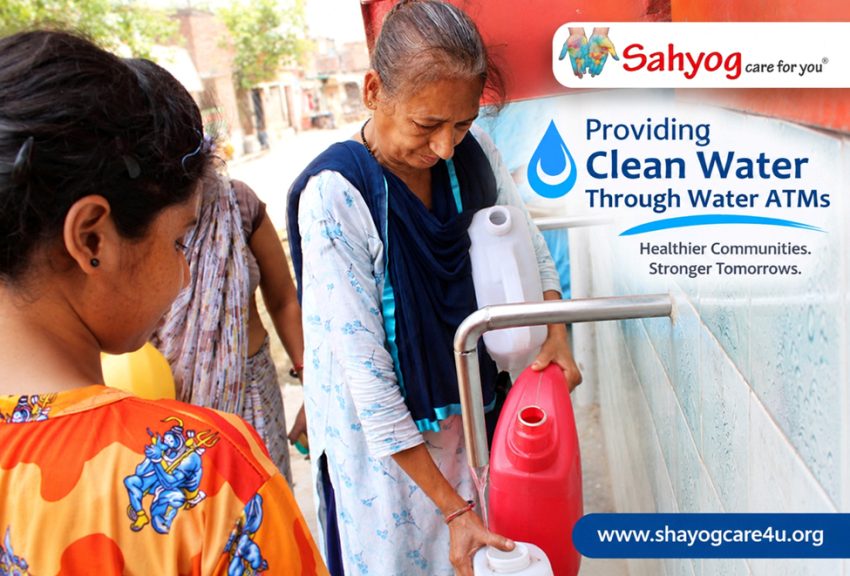
Some of these units run as water ATMs, managed by local Self-Help Groups. Each ATM provides 10 liters of safe drinking water for just ₹1, and it does two other jobs as well: it creates local employment through daily management and operations, and it opens entrepreneurship opportunities for women in running and upkeep. The model shows how safe water access can double as an engine of local economic empowerment.
Each plant comes with a 12-month warranty and quarterly maintenance visits, so the facility is built to last.
That spread across thirteen states is what a reliable NGO with pan India presence can offer a company with operations in several places: one standard, applied everywhere.
-
Does anyone change habits, or just infrastructure?
Habits change when someone works at it. Sahyog Care for You’s Behavior Change Communication programmes run awareness campaigns, community sessions, and school activities that promote hygiene, nutrition, and preventive healthcare. These sessions use simple, relatable messaging and visual tools so even the youngest learners understand.
Two highlights show the record:
- In 2017, the Clean 4 Good Campaign in Delhi gave 2,105 children aged 6 to 14 haircuts, bathing facilities, and handwashing support, and earned a place in the Limca Book of Records.
- WASH sessions have reached 37,000 children across Delhi NCR, building cleanliness habits at an early age.
-
Can a company trust the organization behind it?
Look for a track record. Over two decades, Sahyog Care for You has reached more than 18,14,000 families, 8,03,000 children, and 1,53,000 women. Its recognitions include the We Serve India Award 2025 and the Hope Through Healing Award.
For companies comparing options, a long, documented record and a presence in many states are the signs of an NGO with pan India presence that can carry a programme through, and a track record of continuing support is what makes CSR WASH projects worth funding rather than just announcing.
The Short Version
| Question | Answer in one line |
| Eligible under CSR? | Yes, under Schedule VII |
| Is the need real? | Yes, upkeep and quality gaps remain |
| Toilets | 650 government schools renovated |
| Maintenance | ~200 staff and caretakers trained |
| Water | 39 RO facilities in 13 states, 2,53,000 people daily, ₹1 for 10 litres at water ATMs |
| Habits | 37,000 children in Delhi NCR; 3,25,000 reached overall |
How a Company Can Help?
- Sponsor a water RO facility or water ATM and bring safe drinking water to a community that lacks it.
- Fund school toilet renovations so more children, especially girls, stay in class.
- Back hygiene awareness campaigns that turn one-off facilities into lasting habits.
Clean water and a working toilet are not luxuries. They are the minimum a neighborhood owes its children, and a well-planned CSR rupee can help deliver them.