
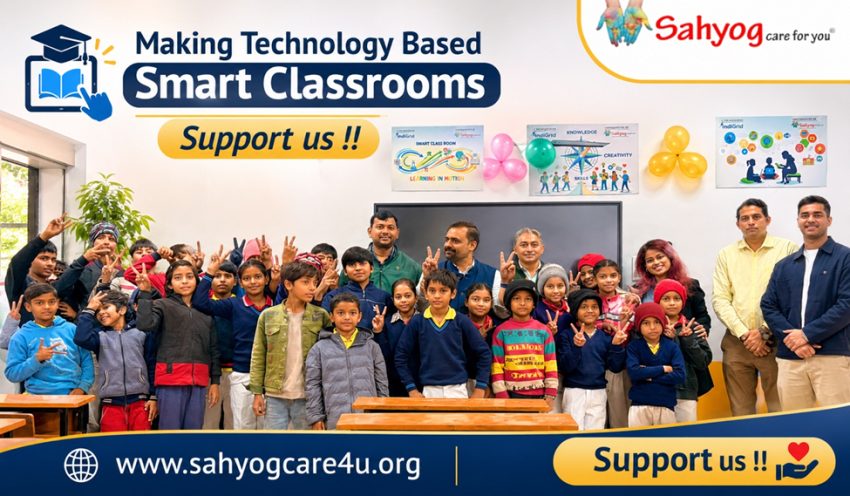
Picture a government school with a brand-new smartboard in the corner. The wall behind it is damp, the lights flicker, and no teacher has been shown how to switch the board on. The technology is there. The learning isn’t.
That scene explains why a Technology-Based CSR project only works when it is built around classrooms, teachers, and children rather than hardware alone. Here is the national report card first, then how Sahyog Care for You approaches it.
The National Report Card (UDISE+ 2024-25)
The Ministry of Education’s latest UDISE+ report shows real progress, and some stubborn gaps.
| Subject | Where India stands |
| Computers in schools | 64.7%, up from 57.2% |
| Internet in schools | 63.5%, up from 53.9% |
| Secondary dropout rate | 8.2%, down from 13.8% in 2022-23’s reporting, with middle level at 3.5% |
| Drinking water facility | available in 99.3% of schools |
The headline is encouraging, but the detail matters. Rural schools lag urban schools by 29 percentage points on internet connectivity, and toilets friendly to children with special needs are present in only about a third of schools. Put simply, more than a third of schools still lack the digital tools many children need, and the children most affected are often in rural areas or have disabilities.
Access to facilities also isn’t the same as quality. A school can have a water facility without the water being safe, and a computer without it being used.
Why Hardware Alone Fails
The most common failure in education technology is the one in the opening scene: equipment installed, nobody trained, no plan for upkeep. An effective Technology-Based CSR project treats the classroom as a system. The room has to be safe and well lit, the teachers have to be confident, and the children, including those with disabilities, have to be able to use what is installed.
That systems view is how Sahyog Care for You works. It is an NGO for child education active since 2002, and its programmes follow a child from the classroom to the library, and from inclusion to extra support.
Smart Shala: Fix the Room, Then Add the Technology
Smart Shala is Sahyog Care for You’s classroom transformation programme. It starts with the room itself: waterproofing, structural repairs, better lighting and ventilation, and restored furniture. Then it adds smartboards with audio support and warranty coverage, along with BALA (Building as Learning Aid) murals that turn bare walls into teaching tools. Teacher training completes the package so the technology gets used.
The programme now runs in 20 schools across 12 states: Delhi, Haryana, Punjab, Jammu & Kashmir, Rajasthan, Gujarat, Chhattisgarh, Jharkhand, Madhya Pradesh, Maharashtra, Tamil Nadu, and Telangana. It reaches an estimated 16,000 children.
Kitab Ghar: A Digital Corner in a Library
Kitab Ghar turns unused school corners into libraries. Two centers run in government schools in Gurugram, each with over 1,000 books, reaching roughly 500 students. Each includes reading corners, computers, and projectors, plus storybooks, encyclopedias, and curriculum material in multiple languages. Teachers and community volunteers are trained in library management so the space stays active.
Saksham Shala: Technology That Includes Every Child
The UDISE+ data shows that inclusion is still a gap, and Saksham Shala works on exactly that:
- A computer lab in a government school in Chhattisgarh serves 800 to 900 students, where children with special needs learn alongside their peers.
- A programme supports children of Delhi Police personnel who are autistic, have speech disorders, or are physically handicapped.
- A Braille classroom in Delhi teaches blind children basic computer skills, proof that digital literacy was never conditional on sight.
The Glass of Water on the Desk
Children learn poorly when they are thirsty or sick. Government data says drinking water facilities exist in nearly every school, but a facility isn’t a guarantee of safe water. Sahyog Care for You’s Project Jal Raksha installs RO/UV water systems of 500 to 1,200 liters per hour in schools, sized to each site.
More broadly, it has installed 39 water RO facilities across 13 states, and over 2,53,000 people rely on them every day. Some units run as water ATMs managed by local Self-Help Groups, dispensing 10 liters of safe water for ₹1. Each plant carries a 12-month warranty and quarterly maintenance visits. A child who drinks safe water attends school more often, and that is an education outcome too.
Learning After the Bell
Technology can’t catch every gap, so Sahyog Care for You runs Remedial Education for children in Classes 2 to 8, aged 6 to 14, at three Delhi centers: Mangolpuri, Nihal Vihar, and Nilothi. Over 2,500 children have studied there since 2002. Bal Panchayat, a children’s leadership council, teaches them to raise local problems and to bring classmates back to school.
A Financial and Digital Literacy programme for children covers savings, financial safety, and awareness of government schemes. Combined, Smart Shala, remedial classes, and Kitab Ghar reach an estimated 20,000 children across 14 states.
What CSR Teams Should Ask
When choosing where to place a Technology-Based CSR project, ask four questions:
- Is the physical classroom repaired before the technology is installed?
- Are teachers trained, with follow-up?
- Does the design include children with disabilities?
- Is there a plan for maintenance and for what happens after the first year?
An NGO for child education that can answer all four, as Sahyog Care for You does across its programmes, gives a company something rarer than an installation: a classroom that keeps working.
How You Can Help
- Sponsor a Smart Shala classroom transformation.
- Fund a Kitab Ghar library in a government school.
- Back Saksham Shala so more children with disabilities get technology that fits them.
- Install a school water facility so every child has safe water at the desk.
A smartboard is only a screen until a trained teacher, a safe room, and a child who is ready to learn stand in front of it.