
Walk into a government school classroom in a small town or village in India, and you’ll often find the same story: peeling walls, leaking roofs, dim lighting, and a blackboard that’s seen better decades. For millions of students, this is the backdrop their entire education unfolds against — not a lack of curiosity, but a lack of infrastructure.
It’s a pattern that repeats across thousands of schools nationwide, from mountain villages to city slums. And it matters more today than ever: as the world moves further into a digital-first economy, a child’s ability to engage with technology in the classroom is becoming as fundamental as reading and arithmetic. Closing this gap isn’t a nice-to-have anymore — it’s foundational to educational equity in India.
Why Digital Education Can’t Wait
The case for digital classrooms in government schools isn’t just about novelty or keeping up with private-school peers. It comes down to three things that directly shape whether a child stays engaged in school or falls behind.
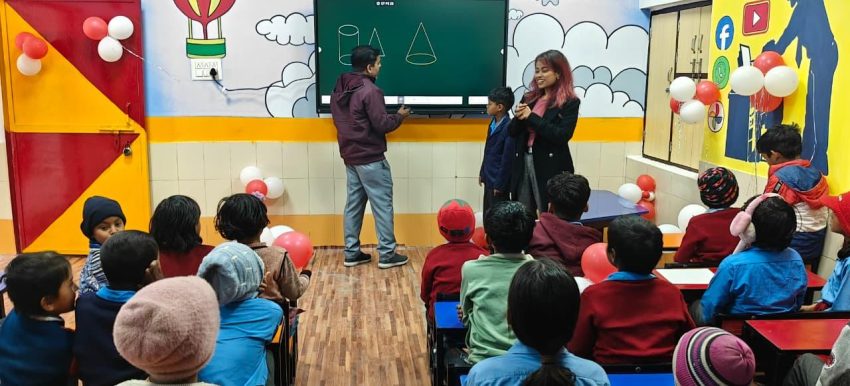
Access to visual and interactive learning. A smartboard turns a static lesson into something a student can see, touch, and interact with — a diagram that moves, a video that explains a concept in seconds, a quiz that gives instant feedback. For students who have never had access to this kind of teaching, the shift in engagement is immediate and visible.
Teacher effectiveness. Even the most dedicated teacher is limited by chalk and a blackboard. Digital tools give teachers new ways to explain difficult concepts, differentiate for different learning speeds, and bring subjects like science and geography to life in ways a textbook alone cannot.
Equity. Digital literacy is no longer optional — it’s a basic requirement for higher education and employment. Children in under-resourced government schools are already starting several steps behind their private-school counterparts. Bridging that gap early, in the classroom, is one of the most direct ways to level the playing field.
This is the thinking behind SmartShala: not technology for its own sake, but technology as a lever to fix a structural gap in how quality education reaches underserved communities.
What SmartShala Actually Does

This is exactly the gap that Sahyog Care For You, an NGO for child education working on the ground across India since 2002, set out to close. Their initiative, SmartShala, is a classroom transformation programme that pairs physical renovation with digital learning tools, turning ordinary, often crumbling classrooms into vibrant, technology-enabled learning spaces.
Unlike initiatives that simply drop a smartboard into a classroom and call it done, SmartShala takes a full-classroom approach. The intervention typically includes:
- Smartboard systems with the necessary accessories, audio support, and warranty coverage, so the technology keeps working long after installation.
- Classroom renovation — waterproofing, better ventilation and lighting, and structural repairs that make the room usable and safe in the first place.
- BALA (Building as Learning Aid) elements — child-friendly murals and painted learning aids that turn even the classroom walls into teaching tools.
- Furniture upgrades, including replacing or restoring benches where needed.
- Teacher training, so that the technology is actually used well rather than sitting idle. This is often the most overlooked — and most important — part of any ed-tech intervention.
It’s a model built around a simple idea: infrastructure only creates impact if it is durable, well-used, and owned by the community it serves.
From Jammu & Kashmir to Tamil Nadu: What Change Looks Like on the Ground
Picture the extremes: a government school classroom in the Kashmir valley, and another nearly 3,000 kilometres away in rural Tamil Nadu. Different climates, different languages, different local realities — but strikingly similar starting points. Damp, discoloured walls. Poor ventilation. Leaking roofs. Little to teach with beyond a blackboard and chalk.
Across that entire stretch of the country, SmartShala follows the same rebuilding process wherever it goes: waterproofing to stop the leaks, better lighting and ventilation, bright BALA murals that turn bare walls into teaching tools, restored furniture, and a smartboard installed and ready for daily use. The result is consistent — a room that goes from barely functional to a model smart classroom, and a group of teachers and students who finally have tools that match their potential.
It’s proof that this isn’t a one-off success story tied to a single state or community. The model travels — from the border regions of the north to the coastal south — without losing its consistency or quality.
The Reach: A Growing Footprint Across India
What makes SmartShala meaningful at scale is that it isn’t confined to one state or one type of geography. Sahyog Care For You has now carried this model of classroom transformation across 14 states in India, supporting an estimated 16,000 children in government schools along the way.
That spread reflects a model that isn’t tied to a single geography or type of community. It’s designed to be replicated: modular enough to scale into new regions without requiring large recurring costs, and structured enough to maintain consistent quality wherever it lands.
Part of a Larger Mission
SmartShala doesn’t exist in isolation. As an NGO for child education and community welfare, Sahyog Care For You runs SmartShala within its broader work across seven key areas: Child Protection, Women Empowerment, Youth Skilling & Employment, Education, Health & Hygiene, Armed Forces Welfare, and Community Development. Over more than two decades, the organization has partnered with government bodies, armed forces, and corporate stakeholders to run programs that reach vulnerable communities across urban slums, rural areas, border regions, and disaster-affected zones.
Education has always been central to that mission, built on the philosophy of Sarvodaya — universal upliftment. SmartShala is simply the most tangible, physical expression of that philosophy: walls repainted, roofs fixed, and a smartboard switched on in a classroom that, until recently, had none of it.
Why It Matters
It’s easy to talk about the “digital divide” in the abstract. SmartShala makes it concrete — a leaking classroom in Kashmir, a school on the Tamil Nadu coast — and then does the unglamorous, necessary work of fixing it, one classroom at a time. Sixteen thousand children across 14 states is not the end point; it’s a working model that has already proven it can travel across states, climates, and communities.
For the thousands of students and teachers who now start their day in a classroom that works — dry, well-lit, and equipped for the kind of learning the rest of the world takes for granted — that is what digital education, done right, actually looks like.
Sahyog Care For You is an NGO for child education and a pan-India nonprofit working since 2002 across education, child protection, women’s empowerment, and community development. To learn more or get involved with initiatives like SmartShala, reach out at sahyogcsrmanager@gmail.com.