

For years, “Digital classrooms” have been sold as the future of education — interactive boards, projectors, tablets, and AI-driven tools replacing chalk, talk, and textbooks. But does the data actually back up the hype, or is this another case of shiny technology outpacing real learning gains?
The honest answer, based on research from universities, government bodies, and international agencies, is: it depends on how the technology is used — but the evidence leans meaningfully in favor of digital classrooms when implementation is done right. That distinction matters most for any NGO for digital classrooms deciding where to put its time and funding.
Here’s what the numbers actually say.
Academic Performance: What Controlled Studies Found
Several peer-reviewed studies have directly compared student performance in digital vs. traditional classrooms using the same syllabus, same teachers, and pre/post-testing.
A 2024 meta-analysis synthesizing 21 empirical studies on digital classrooms found a significant overall positive effect on learning outcomes, with the strongest gains in cognitive and behavioral development. Primary school students showed the greatest improvement, and outcomes were even stronger when digital classrooms were paired with traditional teaching strategies like Problem-Based Learning.
When digital classrooms are implemented well, the data consistently shows better academic outcomes than traditional classrooms — but the pedagogy, not just the hardware, is doing a lot of the work.
The Global Evidence Is More Cautious Than the Marketing
This is where it gets important — and where a lot of EdTech content leaves out inconvenient findings.
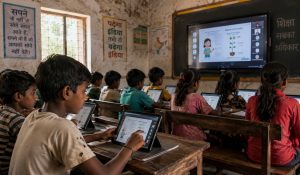
UNESCO’s 2023 Global Education Monitoring Report found that in rural Jharkhand, an independent impact assessment of the Digital Shala program — which pairs low-cost digital classroom tools (Smart TVs, offline content, teacher dashboards) with structured teacher training in government schools — found up to a 27% increase in learning outcomes, after training over 28,000 teachers as part of a state government partnership reaching more than 1.8 million children. Proof that well-designed digital tools can work at scale in rural India, when pedagogy leads and technology supports it.
But the flip side shows up too: UNESCO’s report found that in Peru, distributing over 1 million laptops without integrating them into actual teaching led to no improvement in learning outcomes.
Technology doesn’t automatically improve learning. It improves learning when it’s paired with trained teachers and a clear pedagogical purpose — and can actively hurt outcomes when it’s dropped into classrooms without either.
What’s Happening in Indian Classrooms Specifically
Infrastructure is improving, but unevenly: According to a NITI Aayog report, internet connectivity in Indian government schools jumped from just 8% in 2014-15 to 63.5% in 2024-25 — a dramatic decade of progress. But state-level gaps remain stark: computer facilities are available in only around 25% of schools in states like Bihar and West Bengal, compared to near-universal access in Delhi and Chandigarh.
Digital classrooms are showing real results where they exist: A study by IIM Bangalore, conducted under the Smart Cities Mission, found that the rollout of 9,433 digital classrooms across 2,398 government schools in 71 cities was associated with a 22% increase in overall school enrollment between 2015-16 and 2023-24.
Put together, the evidence doesn’t support “digital classrooms are always better.” It supports something more specific: digital classrooms outperform traditional ones when they’re backed by trained teachers, sound pedagogy, and genuine access — and underperform or make no difference when they’re not.
Case Study: Sahyog Care for You’s Smart Shala Project
As an NGO for digital classrooms working directly in rural India, Sahyog Care for You’s Smart Shala project brought digital classrooms to rural government schools across 12 states — and its implementation sequence is a useful real-world illustration of the exact principle the data above points to: infrastructure and teacher readiness have to come before the technology, not after.
- Building the Foundation First
- Before any digital equipment arrived, teams carried out core civil work — tile work, vinyl flooring, and repairs to floors and walls — to make classrooms structurally usable.
- Underground wiring and dedicated power sockets were installed to support digital systems reliably, addressing a basic infrastructure gap that many EdTech rollouts skip.
- Classrooms were also given an environmental upgrade — wall paintings, educational artwork, awareness graphics, and flex banners — to create a genuinely engaging “Smart Learning” atmosphere, not just a room with a screen in it.
- Installing the Technology Only after this groundwork was complete were Smart Digital Boards and digital learning software installed, ensuring the technology had a stable, functional environment to operate in.
- Training the Teachers Installation wasn’t treated as the finish line. Teachers received basic operational guidance and structured orientation and training, so the technology could actually be used effectively in day-to-day teaching — the same “pedagogy over hardware” factor that separates successful rollouts (like Digital Shala in Jharkhand) from ones that fall flat (like the laptop distribution in Peru).
The Impact Sahyog Care For You Created
- Engaging learning spaces: Traditional classrooms were transformed into student-friendly, technology-enabled environments.
- Enhanced accessibility: Students in remote areas gained access to modern digital learning tools they wouldn’t otherwise have had.
- Increased attendance: Improved facility quality helped strengthen baseline literacy and attendance levels.
- Improved grades: Regular attendance and engaging teaching techniques have improved the marks and grades of children.
The Bottom Line
The data is clear on one point above all: technology alone doesn’t move the needle on learning. It’s the combination of solid infrastructure, trained teachers, and sound pedagogy that turns a digital classroom into a genuine learning upgrade — and Sahyog Care for You’s Smart Shala project is a working example of that principle applied at scale across 12 states. For funders and partners searching for the best NGO in India to back on digital classroom transformation, this is exactly the kind of implementation discipline — infrastructure first, technology second, training always — that separates results from hype.