
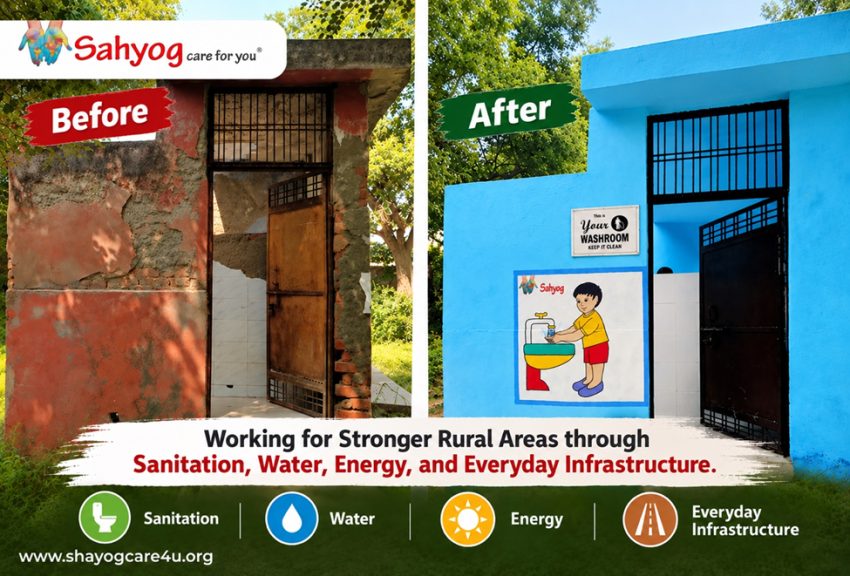
Rural development rarely comes down to one big fix. It’s rarely a single dam, a single scheme, or a single grand announcement that changes a village’s daily life. More often, it’s a toilet that actually gets used because water reaches it, a park that gives a neighborhood somewhere to breathe, a solar panel that quietly cuts a monthly electricity bill, and a booth where a traffic constable can finally use a clean washroom after an eight-hour shift. Real rural development tends to look like a long list of unglamorous, practical fixes, applied consistently, rather than one headline moment.
Rural India’s Development Gap, in Numbers
India’s progress on rural infrastructure over the past decade has been genuinely significant. Under the Swachh Bharat Mission-Grameen, more than 12 crore household toilets have now been built across the country, a scale of construction credited by government estimates with saving roughly 3 lakh children’s lives through improved sanitation and reduced disease transmission. A 2024 study published in Scientific Reports similarly found that Indian districts where toilet construction rose by more than 30% saw measurably lower infant and under-five mortality rates. Yet policy researchers increasingly point to a second, quieter challenge: a household can have a toilet built and still lack safe, functioning sanitation if water doesn’t reach it, if the facility isn’t maintained, or if waste isn’t properly managed afterward. Construction alone doesn’t guarantee a service that actually works day to day, which is exactly where sustained, community-level involvement tends to matter most.
Sahyog Care for You’s Work in Rural Communities
Sahyog Care for You’s rural programs are built around this same understanding: that lasting change comes from maintaining and improving everyday infrastructure, not just building it once. Its Toilet Renovation and Construction program focuses on renovating and building toilets in underserved rural and urban areas, working directly with local authorities and community members so that these facilities are actually maintained and used effectively rather than falling into disrepair within a year or two. This same principle extends into schools through the School Sanitation and Infrastructure Upgrade program, which has renovated and built toilets across government schools in rural Delhi and Haryana. The impact here is especially significant for adolescent girls, since access to clean, private sanitation facilities is one of the clearest, most direct ways to reduce dropout rates among female students who would otherwise leave school once managing personal hygiene became difficult.
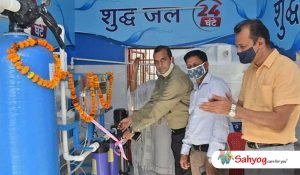
Water access follows a similar logic, and here the reach extends well beyond Delhi alone. Through its Water ATM program, Sahyog Care for You has installed 20 Water ATMs across Delhi and Gurgaon, each dispensing purified water on demand for just ₹1 per 10 liters, placing safe drinking water within reach of communities where traditional supply systems fall short. Alongside these, the organisation has set up a further 19 Water RO plants, provided completely free of cost, across Madhya Pradesh, Maharashtra, Himachal Pradesh, Telangana, Tamil Nadu, Jharkhand, Karnataka, and Rajasthan, extending the network to 39 installations nationwide. Alongside the infrastructure itself, the program also runs awareness efforts on water conservation and sustainable usage, recognizing that access and responsible use need to be addressed together.

Education gets the same hands-on treatment through Smart Shala, which transforms ordinary classrooms into smart, technology-enabled learning spaces equipped with smart boards, digital content, interactive quizzes, and other learning tools. Rural teachers are trained through dedicated Teacher Training Programs so the technology gets used well rather than sitting idle, and the results show up in stronger student engagement, better academic performance, and lower dropout rates across the classrooms where it has been introduced.
On the energy side, the organisation’s Solar Panel Installation program brings renewable energy directly into communities, reducing dependence on non-renewable power, lowering electricity costs, and supporting a level of energy independence that matters most in areas where grid supply is unreliable. Public infrastructure gets similar attention: The Traffic Police Booth Renovation program has upgraded roadside booths with toilets, clean drinking water, and proper seating, addressing the basic working conditions of officers who spend entire shifts on the road, while the Park Renovation and Roadside Beautification program has transformed a neglected park in Gurugram’s rural areas into a usable community space, alongside new tree planting and roadside beautification.
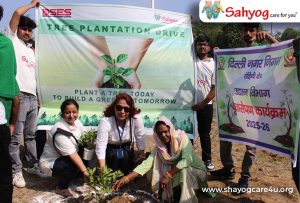
Environmental work rounds out this picture. Sahyog Care for You’s Tree Plantation Drive has distributed and planted 47,000 trees and saplings across Delhi government schools, contributing directly to the city’s green cover while building environmental awareness among students who plant and look after the trees themselves. Running alongside all of this, Community Awareness Programs bring workshops, seminars, and outreach sessions on health, sanitation, and development topics directly to communities, helping residents make informed decisions rather than simply receiving infrastructure without context.
Why a Multi-Sector Approach to Rural Development Works?
What ties all of these programs together is a refusal to treat rural development as a single-issue problem. A village doesn’t just need a toilet, or just clean water, or just a solar panel, it typically needs several of these at once, alongside the awareness and follow-through that keeps each one functioning. This is really what a genuine NGO for rural development looks like on the ground: not one flagship project, but a coordinated set of interventions across sanitation, water, energy, public infrastructure, and environment, each reinforcing the others rather than existing in isolation.
Presence That Actually Reaches Rural Communities
None of this happens from a head office alone. Every one of these programs depends on direct, sustained presence in the communities they serve, working alongside local authorities, school staff, traffic police departments, and residents themselves. That kind of consistent, on-the-ground involvement is exactly what separates an NGO working in rural India in name from one genuinely embedded in the daily life of the villages and towns it serves, showing up not just for a groundbreaking ceremony, but for the maintenance visit a year later too.
Get Involved
Extending this work to more villages, more schools, and more communities depends on continued support. Whether it’s funding a toilet renovation, a new Water ATM or RO plant, a Smart Shala classroom, or a tree plantation drive, every contribution adds another practical piece to rural India’s development, the kind that a genuine NGO for rural development measures not by press coverage, but by whether a facility is still working, still clean, and still in use months and years later. For anyone looking to support an NGO working in rural India with programs spanning sanitation, water, energy, education, and public infrastructure alike, this is exactly the kind of grounded, everyday impact worth backing.