
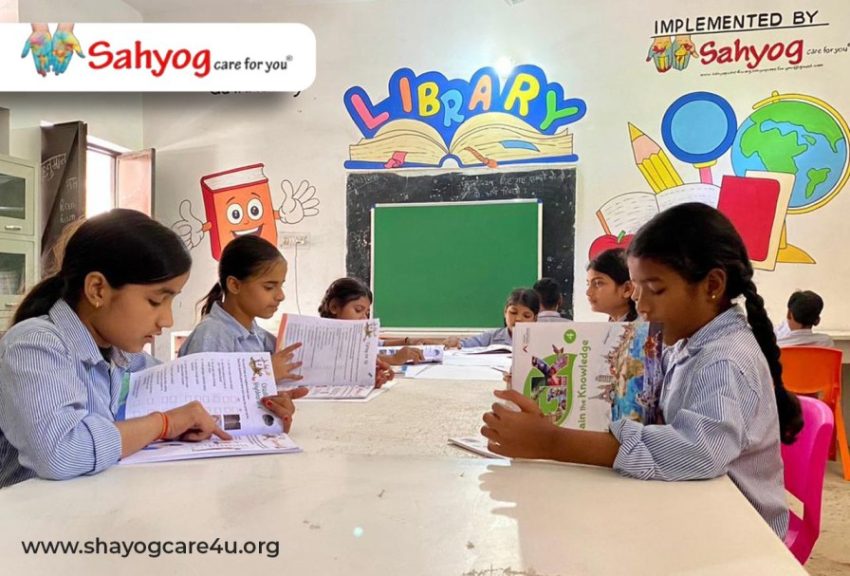
On paper, India’s schools look reasonably well-equipped. Government data has periodically shown that well over eight in ten schools report having “a library.” In practice, that number often hides a much less impressive reality: a locked steel Amirah in a corner of the staff room, a stack of outdated textbooks that nobody has touched in years, and no dedicated space where a child can actually sit down and read. There is a real difference between a school that has a library on a government form and one that has a library that children actually use, and closing that gap takes more than cataloguing—it takes a complete transformation of the space.
Here’s what that transformation process typically looks like when it is done properly.
Stage One: Starting with an Honest Look at the Space
Every library project begins with the same unglamorous first step: identifying a room, often unused or badly underused, and being honest about its condition. Peeling paint, broken fixtures, inadequate flooring, and electrical points that do not work properly can often be part of the starting point in a government school.
This is the stage a genuine NGO for library construction can’t afford to rush or paper over, since getting these basics right first is what makes the room usable at all.
Stage Two: Whitewash, Paint, and BALA Murals
The next stage is where the room begins to look and feel different. Fresh whitewash and paint are not merely cosmetic additions; they can transform a dusty, forgotten room into a space that children want to enter.
Many library renovations go a step further with BALA, or Building as Learning Aid, murals. These murals can cover the walls with alphabets, numbers, maps, illustrations, and other educational concepts that support learning even when no class is in session.
A wall becomes a learning tool. A library starts to look like somewhere worth spending time rather than somewhere books are simply stored.
Stage Three: Fans, Lighting, and Furniture That Make the Room Usable
A freshly painted room without a fan during India’s summer heat, or without proper lighting when natural light fades, can quickly become a space that students do not want to use.
This stage covers the practical essentials: ceiling fans, adequate lighting, and the furniture that actually makes a library functional. This includes sturdy bookshelves, a secure almirah for valuable or delicate materials, and chairs and tables that allow children to sit and read comfortably.
None of this work is glamorous, but it is essential. Without these basic facilities, even the most beautifully painted room may struggle to hold a child’s attention beyond the first visit.
Stage Four: Bringing in the “Smart” Part
The final stage is what turns a renovated reading room into a genuinely smart library: a computer system that gives students access to digital reading materials and learning resources alongside printed books.
This combination allows a library to serve children with different reading levels and interests at the same time—printed resources for some and digital resources for others—without requiring a completely separate room or an entirely different learning environment.
This is often the piece that gets left out when funding runs tight, which is why the support of a committed NGO for library development tends to matter just as much after the renovation as before it.
Why the Full Process Matters, Not Just the First Coat of Paint

It is tempting to consider library construction complete as soon as the walls are painted and a bookshelf or two arrives. Sahyog Care for You’s approach to its work in government schools takes a different view: a library is not complete until a child can walk in, sit down comfortably, choose a book or use a computer, and actually want to come back the next day.
That requires all four stages, not just the first one. It also requires an organization that remains committed to the renovation, furnishing, digital setup, and ongoing maintenance needed to keep a library functional over time rather than simply newly painted for a single inauguration.
For schools, donors, and communities looking for a genuine NGO for library construction partner rather than a one-time paint job, this complete, staged approach can help create a library that children actually use. It’s the same reason a broader NGO for library development effort, one that follows through with furnishing and digital access, tends to make a difference that lasts well beyond the first coat of paint.
Get Involved
Every stage of this process, from whitewashing to electrical work to the final bookshelf, requires consistent support to reach more schools.
Whether it is funding the renovation of a single room, providing furniture and books, or supporting the computer systems that make a library genuinely smart, every contribution can help transform another government school classroom from a “library” on paper into a library that children actually walk into and use.