
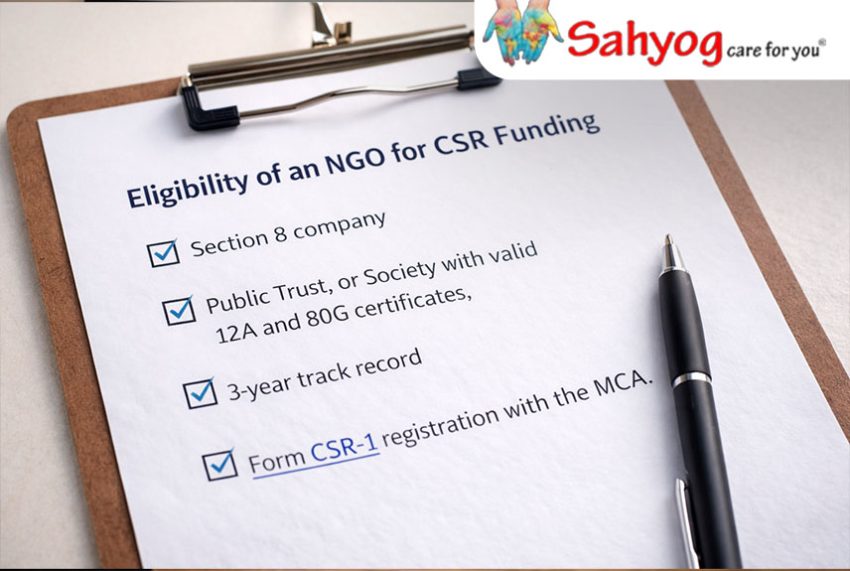
Corporate Social Responsibility (CSR) has turned out to be a significant component of business strategy in India and firms are increasingly collaborating with NGOs to undertake effective development initiatives. A CSR-1 registered NGO is one of them, and it is crucial to make sure that the CSR initiatives are effective, transparent, and compliant. When companies intend on establishing long term and significant partnerships, it is important to learn the roles and functions of a CSR-1 registered NGO. This registration is not just a mere formality but a ticket of merit, readiness and ability to provide social impact.
What Is a CSR-1 Registered NGO?
An organization that has obtained official recognition by the ministry of corporate Affairs (MCA) by submitting Form CSR-1 is a CSR-1 registered NGO. Such registration gives credence to the fact that the NGO qualifies as an entity under the Companies Act, 2013 and is permitted to receive CSR funds and carry out CSR activities on behalf of businesses. Upon registration, the NGO is assigned a special CSR registration number which makes it legitimate and compliant.
Key Roles of a CSR-1 Registered NGO
A CSR-1 registered NGO plays several important roles in a CSR partnership. Their responsibilities extend far beyond project execution and include multiple layers of planning, implementation, and monitoring.
Identifying Community Needs
Among the key functions of a CSR-1 registered NGO is that of determining the actual needs and problems of a local community. Their ground level presence and field experience make them devise initiatives that solve real issues as opposed to imaginary ones. This makes sure that CSR projects are applicable and viable.
Designing CSR Project Frameworks
These NGOs assist the companies in changing their CSR objectives into feasible project models. They give goals, schedules, funds and anticipated results. They are well-developed in the social sphere, which assists them in developing structured programs in line with Schedule VII of the Companies Act in order to ensure full adherence.
Implementing On-Ground Activities
The main role of a CSR-1 registered NGO is to implement CSR projects at the field. This involves carrying out of awareness programs, running of health camps, school improvement, women empowerment, environmental support or provision of basic services. The day to day operations are handled by their teams and liaised with the local stakeholders to ensure a smooth running.
Managing Finances Responsibly
One of the biggest requirements of CSR partners is transparency in fund utilization. Documented expenditure with proper accounting system, CSR-1 registered NGOs have proper accounting systems and are able to ensure that not a single rupee of their funds goes to waste due to poor choices made regarding the project plan. They have financial discipline that creates trust and credibility among corporate partners.
Monitoring, Reporting, and Evaluation
One of the most important roles of these NGOs is the control of the development of projects and assessment of the results. They write elaborated reports, impact assessments, and records, which assist companies to conform to the compliance requirements. These lessons also help organizations to refine the future CSR strategies.
Why Companies Prefer CSR-1 Registered NGOs
CSR-1 registration assures companies that the NGO:
- Adheres to regulation standards.
- Has a history of adopting social initiatives.
- Follows strong governance and financial practices
- Can ensure transparency, accountability, and measurable impact
This facilitates the ease of collaborating, complying and making a difference.
Conclusion
CSR-1 registered NGO is not simply an implementing partner: it is a strategic partner in the social development aims of a company. These NGOs make sure that CSR initiatives bring long-term gains to communities by identifying needs, designing projects, managing operations and delivering measurable impact. Knowing their roles and functions, will enable companies to develop more effective partnerships and promote significant social change in India.